
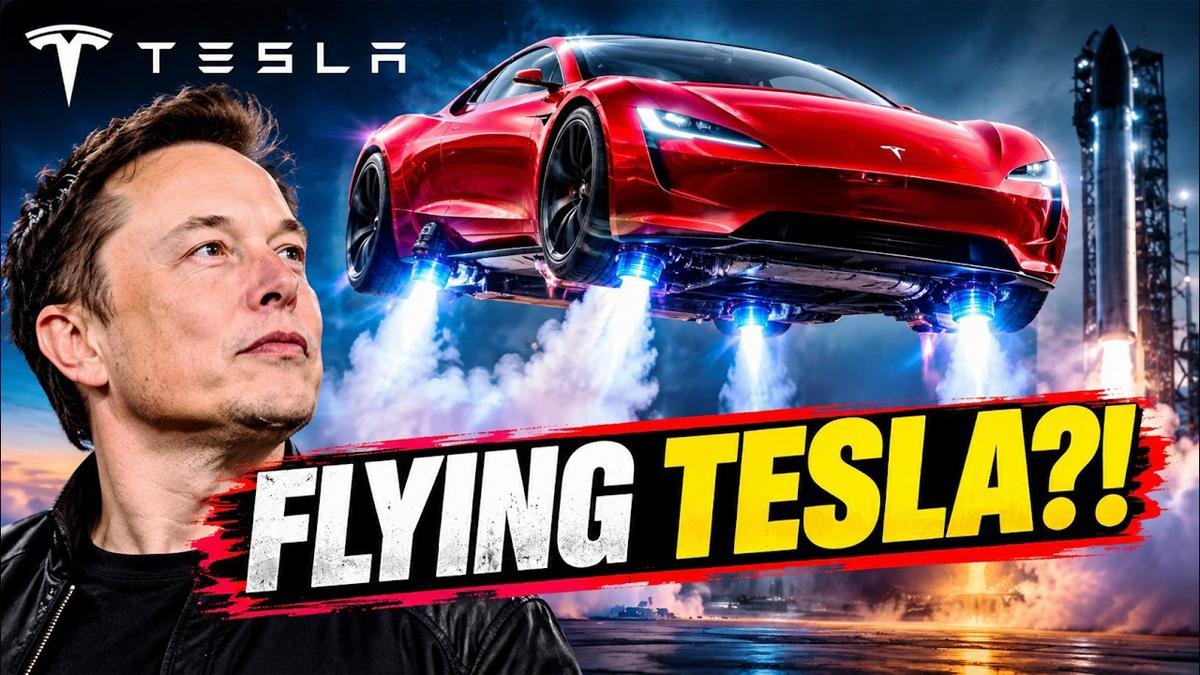
Elon Musk’s vision of a flying car has taken a significant step toward reality with the unveiling of the next-generation Tesla Roadster in October 2026. Combining electric vehicle engineering with aerospace-inspired propulsion, the futuristic sports car has demonstrated extraordinary manoeuvres, including briefly leaving the ground and performing a mid-air flip. Tesla says production is planned to begin in 2028, although commercial availability and regulatory approval remain important questions.
But how does a car designed primarily for roads generate enough force to lift itself into the air? The answer lies in three technologies: an electric drivetrain, a multi-mode suction system that increases downforce, and cold-gas thrusters developed with technology associated with SpaceX.
These innovations could redefine high-performance automotive engineering. However, understanding the difference between a flying demonstration and a practical, road-legal flying vehicle is essential.
What Is Tesla’s Flying Roadster?
The next-generation Roadster is an electric sports car developed by Tesla, the electric vehicle manufacturer led by Elon Musk. Unlike conventional electric supercars, the vehicle’s most advanced configuration incorporates aerospace-inspired hardware intended to produce additional thrust and enable brief airborne manoeuvres.
Tesla originally announced its second-generation Roadster in November 2017. Its development and expected launch date have changed repeatedly since then. The October 2026 unveiling introduced a redesigned vehicle and renewed attention to the proposed SpaceX-related thruster technology.

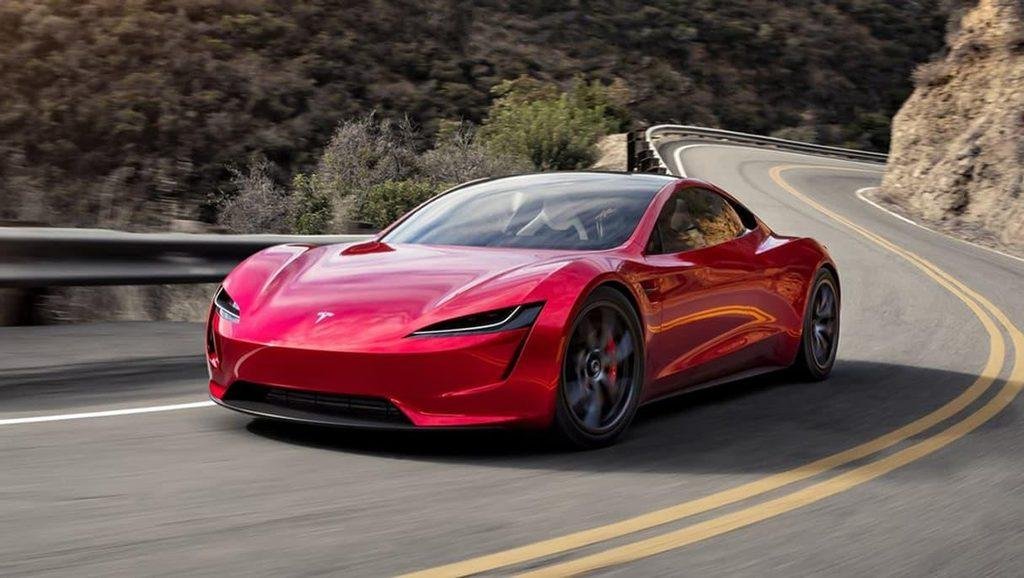
The latest concept is presented in three configurations:
- Performance: An electric sports car with active aerodynamics and a multi-mode suction system.
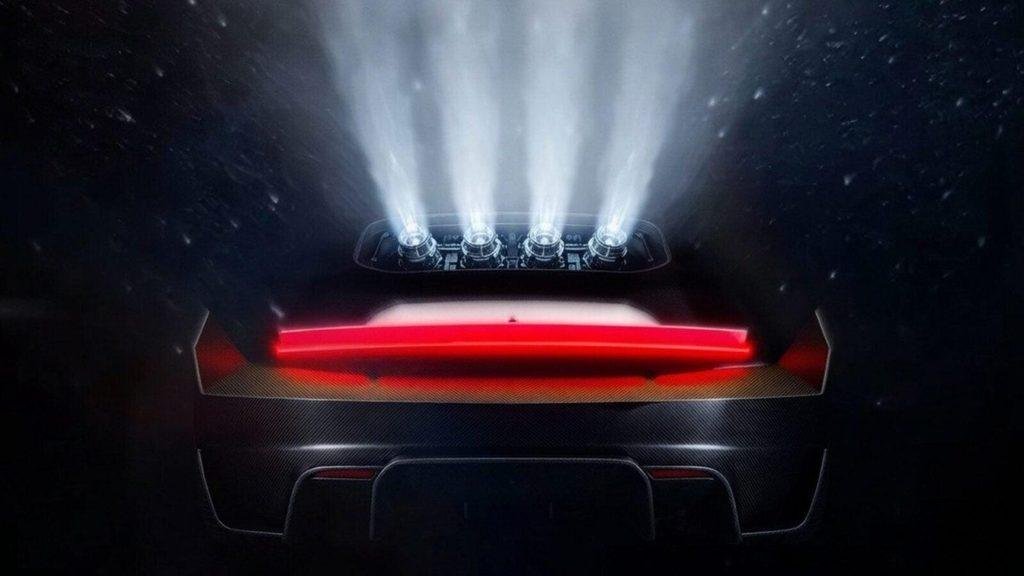
- Thrust: Adds rear-mounted cold-gas thrusters to the suction system for extreme acceleration.
- Rocket: An invitation-only configuration featuring thrusters positioned around the vehicle to support upward thrust and rotational movement.
Tesla’s website explicitly states that the Rocket configuration is not approved for public-road use. Consequently, describing every Roadster variant as a fully road-legal flying car would be misleading.
How Was Tesla’s Flying Car Created?
The vehicle’s unusual capabilities result from combining established electric propulsion principles with specialised aerodynamic and compressed-gas systems. Each technology serves a different purpose, and their integration is what makes the demonstration distinctive.
1. Multi-Mode Suction System: How the Car Stays Attached to Surfaces
A conventional sports car relies on its tyres, suspension and aerodynamic bodywork to maintain contact with the road. At high speeds, airflow around the body can generate downforce, pressing the tyres against the driving surface and improving traction.
Tesla’s proposed multi-mode suction system takes this principle further.
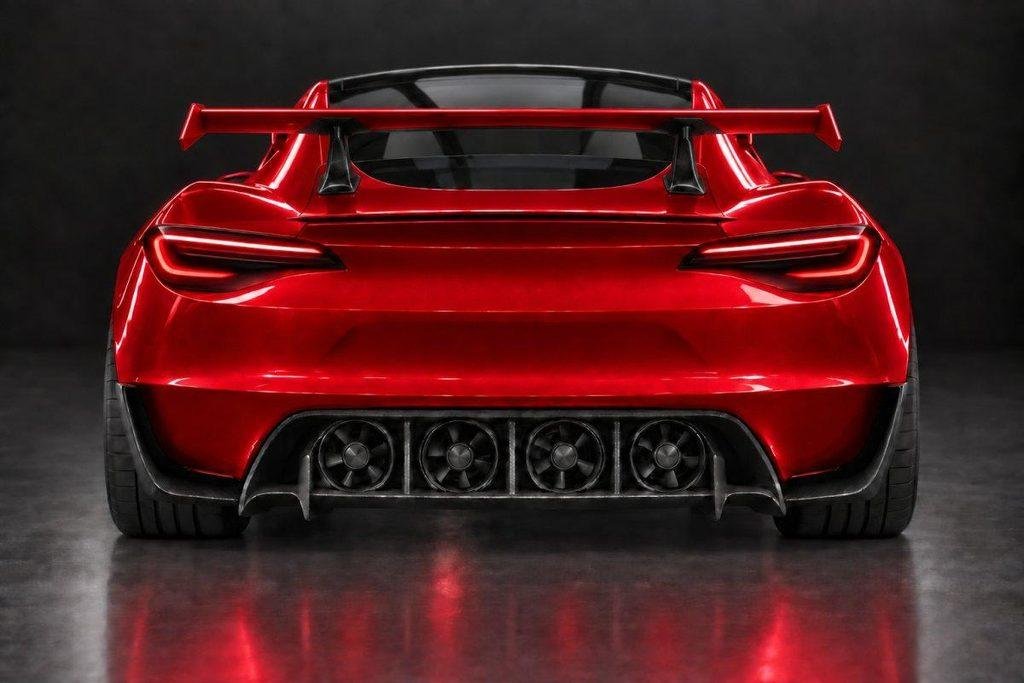
The system uses powered fans and an underbody sealing arrangement to remove air from beneath the vehicle. The resulting pressure difference produces a force that pulls the car toward the surface. Tesla says this arrangement can generate enough downforce to hold the vehicle upside down, even when stationary, under the specified operating conditions.
The benefits of increased downforce include:
- Greater tyre loading during aggressive cornering.
- Improved potential for acceleration and braking without losing traction.
- Better control during high-speed manoeuvres.
- Increased grip at low speeds, where conventional aerodynamic downforce is limited.
Tesla has promoted downforce approaching or exceeding twice the vehicle’s weight in certain configurations. This is commonly described as approximately 2g of downforce, although actual performance depends on operating conditions and requires independent validation.
Importantly, the suction system does not make the car fly. Its primary purpose is to increase the force pressing the vehicle against a surface. The thrusters are responsible for producing the upward force needed for airborne movement.
2. Cold-Gas Thrusters: The Technology Behind the Flying Demonstration
The second technology is the most unusual component of the flying Roadster: cold-gas thrusters.
Unlike conventional rocket engines, which typically generate thrust through hot combustion gases, cold-gas thrusters release pressurised gas through specially designed nozzles. The gas accelerates outward, producing a reaction force that pushes the vehicle in the opposite direction.
The system is associated with aerospace engineering, where cold-gas propulsion is used for attitude control and small adjustments to spacecraft orientation.
In Tesla’s proposed Roadster configurations, the technology has several applications:
- Forward thrust: Additional propulsion can increase acceleration beyond what the electric drivetrain provides alone.
- Upward thrust: Appropriately directed nozzles can produce lift, allowing brief airborne movement.
- Rotational control: Multiple thrusters can create forces and torques that help rotate or stabilise the vehicle.
- Flight stabilisation: Rapid thrust adjustments may help control the vehicle during short airborne manoeuvres.
Tesla describes the Rocket configuration as incorporating thrusters around the vehicle’s perimeter, enabling forward, upward and lateral rotational movement. The company also says electrically actuated controls can make rapid adjustments to thrust.
The crucial engineering challenge is generating enough thrust to overcome gravity while maintaining a controlled orientation.
For a vehicle to lift off vertically, its upward thrust must exceed its weight. However, achieving lift is only the beginning: the vehicle must also maintain balance, control its trajectory and return safely to the ground.
The public demonstration does not, by itself, establish how long the vehicle can remain airborne, how far it can travel in flight or how reliably the system will operate under different environmental conditions.
3. Electric Motors: The Foundation of Extreme Acceleration
Although the thrusters attract the most attention, the Roadster remains fundamentally an electric vehicle.

Electric motors convert battery-stored electrical energy into mechanical torque. Their ability to deliver substantial torque at low rotational speeds makes them particularly suitable for rapid acceleration.
Tesla has promoted a sub-one-second 0–60 mph acceleration claim for the thruster-equipped configuration. This corresponds to approximately 0–97 km/h in under one second. However, the figure is a manufacturer claim rather than an independently established production-car record.
The distinction between electric propulsion and thruster assistance is important.
Electric motors drive the wheels, transmitting force to the road through the tyres. Cold-gas thrusters produce reaction forces directly by expelling gas. The suction system, meanwhile, increases the force pressing the tyres against the surface.
These systems address different physical limitations:
| Technology | Primary function |
|---|---|
| Electric motors | Deliver wheel torque and road acceleration |
| Suction fans | Increase downforce and surface grip |
| Cold-gas thrusters | Provide additional thrust and enable brief airborne manoeuvres |
| Active aerodynamics | Adjust airflow and aerodynamic forces |
Combining these technologies could produce exceptional acceleration and handling. Nevertheless, the precise performance of a production vehicle will depend on its final mass, battery output, tyre characteristics, propulsion configuration and control systems.
Can the Tesla Roadster Really Perform Somersaults?
The October 2026 demonstration showed the redesigned Roadster performing dramatic manoeuvres, including a mid-air flip and movements involving a suction-based system. These demonstrations attracted attention because they combined the appearance of a conventional supercar with aerospace-inspired propulsion.
A controlled aerial rotation is physically possible when the vehicle generates sufficient thrust and rotational torque. By varying the direction and magnitude of forces applied at different points around the vehicle, its orientation can be changed during flight.
However, an airborne stunt should not be confused with practical flight.
A road vehicle is not automatically a safe aircraft simply because it can lift off the ground. Practical aerial transportation requires reliable flight controls, adequate endurance, predictable handling, emergency procedures and systems designed to protect occupants and people nearby.
The demonstrated manoeuvres therefore represent a specialised engineering capability, not proof that the Roadster can replace an aircraft or function as an everyday flying taxi.
Will Tesla’s Flying Car Be Available by 2028?
Tesla has announced plans to begin Roadster production in 2028. However, this is a planned production timeline, not a guarantee that every version will reach customers that year. Several factors will influence the actual launch.

Production and engineering validation
The company must translate its demonstration vehicle into a commercially manufacturable product. This involves testing structural durability, thermal management, battery performance, braking, handling, and the reliability of specialised propulsion equipment.
Safety and regulatory approval
The standard Roadster and the Rocket configuration have different intended capabilities. Tesla’s website states that the Rocket version is not approved for public-road use. The company will need to address the relevant regulatory requirements for each configuration and market.
Cost and practical usability
The most advanced configuration requires specialised hardware, pressure vessels, thrusters and additional control systems. These components could increase manufacturing complexity, maintenance requirements and operating costs.
Consequently, even if production begins in 2028, the availability of the most advanced configuration may be limited.
For prospective buyers in India, local vehicle certification, import requirements, and applicable road-safety regulations would also need to be considered. A global unveiling does not automatically mean that every version can legally operate on Indian roads.
Major Challenges Facing the Flying Tesla Roadster
Despite its technological ambition, the vehicle faces significant engineering and regulatory challenges.
1. High-pressure gas storage: Pressure vessels must withstand demanding operating conditions. Any production design requires robust containment, inspection procedures, and emergency safeguards.
2. Flight stability: A compact vehicle with a shifting centre of mass must remain controllable during lift-off, rotation and landing. Small thrust-control errors could produce substantial changes in orientation.
3. Limited flight endurance: Cold-gas propulsion consumes stored gas. Its practical flight duration and range depend on the available gas supply, pressure, nozzle performance, and vehicle mass.
4. Public safety: A vehicle capable of leaving the ground introduces risks that ordinary road-car safety systems are not designed to address. Uncontrolled flight or an unexpected landing could endanger passengers and bystanders.
5. Legal restrictions: Automotive regulations do not automatically authorise flight. Aviation-related requirements may also become relevant, depending on the vehicle’s capabilities and intended use.
These challenges explain why a successful demonstration is only one stage in developing a commercially viable vehicle.
Conclusion: Is the Flying Tesla Roadster the Future of Transportation?
Tesla’s next-generation Roadster represents an ambitious combination of electric vehicle technology, advanced aerodynamics, and aerospace-inspired propulsion. Its suction system is designed to increase grip, while cold-gas thrusters provide additional force for extreme acceleration and brief airborne manoeuvres.
The planned 2028 production start makes the project worth watching, but important uncertainties remain. Performance claims require independent validation, and the Rocket configuration is explicitly not approved for public-road use.
The Roadster may demonstrate new possibilities for high-performance engineering, yet its long-term significance will depend on more than spectacular stunts. Safety, reliability, regulatory compliance, and real-world usability will determine whether this technology evolves into a practical product or remains a specialised supercar concept.
For now, the most accurate conclusion is that Tesla has presented a remarkable vision of a flying-capable sports car, not a universally road-legal flying vehicle ready for everyday transportation.
Frequently Asked Questions (FAQs)
1. How does Tesla’s flying car work?
The Roadster combines electric motors with a multi-mode suction system and, in its most advanced configuration, cold-gas thrusters. The fans increase downforce, while the thrusters can provide additional forward and upward force.
2. Can the Tesla Roadster really fly?
Tesla describes its Rocket configuration as capable of flight-like manoeuvres using cold-gas thrusters. However, its demonstrated capabilities do not establish that it can perform sustained, practical flight like an aircraft. The Rocket version is not approved for public-road use.
3. How fast is the new Tesla Roadster?
Tesla has promoted acceleration from 0 to 60 mph in under one second for the thruster-equipped configuration. This is approximately 0–97 km/h. The claim should be distinguished from independently verified production-vehicle performance.
4. When will the flying Tesla Roadster be released?
Tesla has announced plans to begin production in 2028. Actual customer deliveries, regional availability, and the launch timing of individual configurations remain subject to confirmation.
5. What are cold-gas thrusters?
Cold-gas thrusters are propulsion devices that expel stored pressurised gas through nozzles to generate thrust. They can produce linear forces and rotational torque without relying on combustion inside the thruster.
6. Is the Tesla flying car legal in India?
The Rocket configuration is explicitly not approved for public-road use. Other configurations would still need to satisfy applicable Indian vehicle regulations and certification requirements. Any future permission for airborne operation would require separate consideration under the relevant rules.
7. What makes the Roadster different from a conventional electric supercar?
Its defining feature is the proposed integration of suction-based downforce and cold-gas propulsion. Conventional electric supercars rely primarily on wheel-driven electric motors and aerodynamic engineering, whereas the Roadster’s advanced configurations introduce additional thrust for specialised manoeuvres.