
The most important moment in the September 30, 2026 Flydubai emergency was not simply the aircraft’s sudden descent. It was the moment when Captain Smit Machchhar, despite being seriously injured, managed to open the cockpit door. That action changed the entire situation.
According to reporting by the Associated Press, Reuters, and other outlets, Flydubai Flight FZ1073 was flying from Dubai to Tel Aviv with 174 people aboard when the co-pilot, identified in multiple reports as Omani national Hamam al-Hammami, allegedly attacked Captain Machchhar inside the cockpit and attempted to take control of the Boeing 737. The aircraft subsequently went into a dramatic descent before control was recovered and the aircraft landed safely in Tabuk, Saudi Arabia. Reuters: The incident has raised a difficult aviation-security question If cockpit doors are deliberately designed to prevent people outside the flight deck from entering, what happens when the threat is already inside?That question goes to the heart of modern aviation security.Cockpit doors became dramatically more secure after the September 11 attacks. Their purpose is straightforward: prevent an unauthorized person in the cabin from forcing their way into the flight deck and taking control of an aircraft. Modern flight-deck doors are reinforced and electronically controlled, while regulations require emergency mechanisms that can allow authorized cabin crew to gain access if flight crew members become incapacitated. ICAOhttps://bbctimesnews.com/saudi-arabia-vs-houthis-after-the-strait-of-hormuz-is-the-red-sea-the-next-oil-crisis-flashpoint/
But every security system involves trade-offs. A door designed to keep an attacker out can also make it harder for people outside the cockpit to intervene when the person creating the danger is already inside. The Flydubai incident brought that paradox into extraordinary focus.
What Happened on Flydubai Flight FZ1073?
On September 30, 2026, Flydubai Flight FZ1073 departed Dubai for Tel Aviv.
According to flight-tracking information cited by news organizations, the Boeing 737 climbed to approximately 34,000 feet before beginning an extraordinary descent. AP reported that the aircraft fell from roughly 33,000 feet to 17,000 feet in about a minute before the situation stabilized. Reuters reported a descent of more than 14,000 feet in approximately 30 seconds during one portion of the event. Reuters
Passengers initially had little idea what was happening.
From the cabin, a sudden descent could resemble severe turbulence or another aircraft emergency. But the situation was allegedly far more serious.

Reports indicate that the co-pilot had attacked Captain Machchhar.
The UAE subsequently described the incident as a suspected terrorist operation, while investigations continued into the attacker’s motive, planning and possible connections. Al Jazeera reported that the UAE Attorney General said investigators had determined that the co-pilot had begun carrying out what authorities described as a terrorist act. Al JazeeraYet the crucial question was not simply why the attack happened.It was: How could anyone outside the cockpit reach the pilots quickly enough to stop it?The answer depended on one physical barrier—the cockpit door.
Why Cockpit Doors Are So Difficult to Open
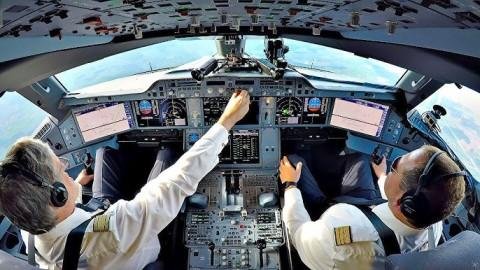
To understand the significance of Captain Machchhar’s action, it is necessary to understand what a modern cockpit door is designed to do.
The cockpit door is not an ordinary aircraft door.
It is a security barrier.
Following the September 11, 2001 attacks, aviation authorities placed enormous emphasis on preventing unauthorized access to flight decks. Modern commercial aircraft use reinforced flight-deck doors designed to resist forced intrusion. The FAA’s certification guidance specifically addresses resistance to forced entry and attempts involving simple tools. Federal Aviation Administration

European certification requirements likewise require aircraft with lockable cockpit doors to provide an emergency means of allowing a flight attendant to enter the flight deck if the flight crew becomes incapacitated. EASA
This creates two competing objectives:
Objective 1: Keep unauthorized people out
A hijacker or violent passenger must not be able to break through the door.
Objective 2: Allow authorized people in during an emergency
If the pilots are unconscious, incapacitated or otherwise unable to respond, cabin crew need a way to enter.
The entire system is therefore designed around controlled access—not unrestricted access.
Can the Cockpit Door Be Opened From Outside?
The short answer is:
Yes, in an emergency—but not simply by physically forcing it open.
The exact system varies by aircraft and operator, but modern aircraft generally incorporate an emergency access procedure.
On aircraft such as the Boeing 737, cabin crew can use an access system to request entry. The system can incorporate an emergency keypad and a delay mechanism. If the pilots do not respond, emergency access may eventually be permitted, depending on the configuration and procedures. Al Jazeera reported that Boeing 737 flight-deck access systems normally remain in an automatic locked mode during flight, while an emergency keypad can initiate an emergency-entry sequence. Al Jazeera
But there is an important distinction:
An emergency access system is not the same thing as a guaranteed external override.
The purpose is to prevent an attacker in the cabin from simply entering a code and walking into the cockpit.
A person inside the cockpit retains significant control over access.
US regulations, for example, require procedures involving verification of the area outside the flight-deck door and authorization by the flight crew before the door is unlocked during flight. Legal Information Institute
That makes sense from a traditional hijacking perspective.
Imagine an attacker standing outside the cockpit.
If the attacker could simply enter an emergency code and immediately open the door, the entire purpose of the reinforced cockpit door would be weakened.
Therefore, aviation security deliberately introduces time, verification and pilot control into the access process.
And that is exactly where the Flydubai incident becomes so interesting.
The Door Was Designed to Stop an Attacker—But the Attacker Was Already Inside
The central security problem in FZ1073 was fundamentally different from the scenario cockpit doors were primarily designed to address.
The threat was not a passenger trying to enter the cockpit.
The threat was allegedly a member of the cockpit crew.
That changes the security equation completely.


If an attacker is outside the cockpit, the door is an enormous advantage.
If the attacker is already inside, the same door can become a barrier preventing intervention.
This is why Captain Machchhar’s ability to open the door became so consequential.
According to reporting from the Times of Israel, Machchhar later explained that the door could be opened from inside using a twist mechanism, while people outside were attempting to use the code. He said the attacker was preventing the external code process from succeeding and that he eventually reached the internal mechanism and opened the door. The Times of Israel
That action created an opportunity.
Passengers and crew could reach the cockpit.
The attacker could be physically restrained.
Additional pilots who were aboard the aircraft could assist with flying the plane.
And the aircraft could be brought out of the dangerous descent.
Why Opening the Door Was the Turning Point
The incident can essentially be divided into two phases.
Phase One: The cockpit was inaccessible
The attacker was inside.
Captain Machchhar was injured.
The aircraft was descending.
People in the passenger cabin could not simply enter the cockpit.
The cockpit door therefore represented a physical boundary between the people capable of intervening and the person controlling the flight deck.
Phase Two: The door opened
Once the door opened, the situation changed immediately.
Passengers could physically reach the cockpit.
The attacker could be confronted.
The injured captain no longer had to fight the attacker alone.
Other crew members could participate.
And additional qualified pilots reportedly helped restore control.
Reuters reported that a reserve Flydubai crew that was already aboard the aircraft subsequently took control and landed the plane safely at Tabuk. Reuters
This is why the door was more than a piece of aircraft hardware.
It became the decisive interface between security and intervention.

A Door That Protects Against Hijacking Can Create a Different Risk
This is one of the most important lessons from the incident.
Aviation security cannot optimize for only one threat.
The industry must consider at least two fundamentally different scenarios:
- An unauthorized person tries to enter the cockpit.
- An authorized person inside the cockpit becomes the threat.
The first scenario is the classic hijacking problem.
The second is an insider-threat problem.
The security architecture for one can conflict with the security architecture for the other.
A cockpit door that is extremely resistant to forced entry is desirable in the first scenario.
But if both pilots are unable—or unwilling—to open it in the second scenario, the cabin crew and passengers may face a serious intervention problem.
This does not mean cockpit doors should become easier to penetrate.
Quite the opposite.
The solution has to be more sophisticated than simply weakening the door.
The 2013 LAM Mozambique Airlines Disaster
History demonstrates why cockpit isolation became so important.
On November 29, 2013, LAM Mozambique Airlines Flight 470 crashed in Namibia, killing all 33 people aboard.
Investigators concluded that the captain deliberately brought the aircraft down after the first officer left the cockpit to use the lavatory. Reports said the cockpit door was locked and the first officer was unable to regain access. euronews
The circumstances are strikingly relevant to today’s debate.
The cockpit door worked exactly as a security barrier.
But the security barrier also isolated the first officer from the person controlling the aircraft.
According to aviation reporting, the captain changed the aircraft’s altitude repeatedly and initiated a fatal descent while the first officer was outside. Aviation Week
The disaster demonstrated the devastating consequences of an insider threat combined with cockpit isolation.
The Germanwings Tragedy and the Same Fundamental Problem
The issue became even more prominent with Germanwings Flight 9525 in 2015.
In that disaster, the co-pilot deliberately locked the captain out of the cockpit while the captain was away.
The aircraft was subsequently flown into mountainous terrain, killing all 150 people aboard.
The circumstances were different from both LAM 470 and Flydubai FZ1073, but the fundamental problem was similar:
A person inside the cockpit had control while another authorized pilot was outside.
The difference with Flydubai was crucial.
Captain Machchhar was inside the cockpit.
He was fighting for control.
And, despite being injured, he ultimately managed to open the door.
That gave other people access to the cockpit before the aircraft could be lost.
The Modern Security Debate: External Access vs Internal Threats
The aviation industry therefore faces a difficult balancing act.
A cockpit door must be:
- strong enough to resist forced entry;
- secure enough to prevent unauthorized access;
- capable of controlled emergency access;
- resistant to manipulation;
- compatible with pilot and cabin-crew procedures;
- usable during emergencies;
- integrated with surveillance and communication systems.
The FAA has already recognized the vulnerability created when cockpit doors must be opened.
In 2023, the FAA finalized requirements for physical secondary barriers on certain passenger aircraft. These barriers are designed to provide an additional layer of protection whenever the flight-deck door itself has to be opened. Dynamic Regulatory System
That illustrates an important principle:
The future of cockpit security is not necessarily about making one door stronger. It is about building multiple layers of protection.
Why a Single Door Should Never Be the Entire Security System
Modern aviation increasingly relies on layered security.
The cockpit door is only one component.
Other layers can include:
Airport security
Pilots and crew must pass security screening before reaching the aircraft.
Background checks
Airlines conduct employment and security checks on flight crew.
Medical and psychological evaluation
Pilot fitness is part of aviation safety, although the precise standards and procedures vary by jurisdiction.
Crew procedures
Airlines have rules governing when one pilot can leave the cockpit and how access is controlled.
Cabin surveillance
Crew can monitor the area around the cockpit.
Emergency access procedures
Cabin crew need procedures for situations in which flight crew are incapacitated.
Secondary barriers
Some regulatory systems now require additional barriers to protect the flight deck while its primary door is open. Dynamic Regulatory System
The Flydubai incident demonstrates why every layer matters.
If one layer fails, another may still prevent catastrophe.
Who Is Hamam al-Hammami?
The suspected attacker has been identified by multiple media organizations as Hamam al-Hammami, an Omani national.
However, it is important to distinguish confirmed information from allegations still under investigation.
Al Jazeera, citing AP and other reporting, said al-Hammami had previously worked in aviation and had reportedly been removed from flight duties in Oman amid concerns about alleged extremist views. The precise nature of those concerns and whether they were adequately communicated to subsequent employers remain subjects of investigation. Al Jazeera
ABC News similarly reported that officials familiar with the investigation said he had been identified as a security risk during his time with Oman Air and that extremist material had allegedly been found during his training. ABC News
These reports raise a much broader aviation-security question:
What information should follow a pilot when that pilot moves between airlines and countries?
The question is especially difficult because aviation is inherently international.
A pilot may:
- train in one country;
- obtain licenses recognized elsewhere;
- work for an airline in another country;
- fly across several jurisdictions;
- and operate aircraft into countries with different security policies.
Information-sharing failures can therefore become international safety problems.
The Pilot Nationality Question
The incident has also generated questions about whether pilots from countries without diplomatic relations with Israel can operate flights into Israel.
The question needs careful treatment because nationality, citizenship, licensing, airline employment and diplomatic restrictions are separate issues.
A pilot does not necessarily need to be a citizen of the destination country to fly there.
Airlines operate internationally with multinational crews.
What matters is the combination of:
- aviation regulations;
- airline operating permissions;
- bilateral or multilateral air-service arrangements;
- immigration rules;
- security requirements;
- crew documentation;
- nationality restrictions where applicable.
Therefore, the simple question “Can a Pakistani pilot fly an aircraft into India?” cannot be answered merely by looking at diplomatic relations.
The legal and operational framework matters.
Could a Pakistani Pilot Fly an Aircraft Into India?
This question has attracted attention because India and Pakistan have extremely restricted aviation relations.
However, nationality alone does not necessarily determine whether a pilot can operate an international flight.
A foreign airline may employ pilots from many nationalities.
The critical questions would include:
- What restrictions apply to the airline?
- What restrictions apply to crew nationality?
- What visas or crew documents are required?
- What bilateral aviation agreements are in force?
- Are there security restrictions imposed by the destination country?
- Does the airline have an approved procedure for deploying that particular crew member?
Therefore, it would be misleading to say that a Pakistani national could automatically fly an aircraft into India simply because the person held another country’s citizenship—or that such a flight would automatically be prohibited because of Pakistani nationality.
The precise rules would depend on the current regulatory and diplomatic framework.
This is an important distinction because aviation security is governed by specific operational rules, not assumptions about nationality.
The Bigger Issue: How Should Airlines Handle Pilot Security Information?
The most difficult questions surrounding the Flydubai case concern not the cockpit door itself but what happened before the aircraft ever took off.
If credible security concerns about a pilot exist, how are they communicated?
Suppose a pilot leaves Airline A and joins Airline B.
Should Airline A be permitted—or required—to communicate security concerns to Airline B?
What information can legally be shared?
How is inaccurate information prevented from destroying a pilot’s career?
And how can airlines distinguish between:
- a genuine security warning;
- a medical concern;
- a disciplinary issue;
- a political or ideological allegation;
- and an unverified suspicion?
These are exceptionally complicated questions.
Aviation safety depends on reliable information.
But security screening also depends on due process and accurate assessments.
The Flydubai investigation may therefore have consequences well beyond the individual flight.
Could the Cockpit Door Have Been the Difference Between Life and Death?
In the specific circumstances reported from FZ1073, it appears that access to the cockpit was central to the rescue.
Reuters reported that the wounded captain managed to open the door, allowing passengers and crew to intervene. Reuters
AP similarly described Machchhar’s action as critical to allowing passengers and crew to overpower the attacker. AP News
But it is important not to reduce the entire rescue to one individual action.
Several elements appear to have contributed:
- the captain resisted the attack;
- the cockpit door eventually opened;
- passengers moved toward the cockpit;
- an attacker was physically subdued;
- other qualified personnel were available;
- control of the aircraft was restored;
- and the aircraft reached a safe landing location.
The survival of everyone aboard was therefore the result of multiple layers of human intervention.
The Extraordinary Role of Other Pilots on Board
One particularly important detail is that additional qualified pilots were reportedly present among the passengers.
According to Reuters, a reserve Flydubai crew on board took control of the aircraft after the cockpit was secured. Reuters
That is significant because controlling a modern passenger aircraft during an emergency is not a simple task.
The people involved must understand:
- aircraft flight controls;
- autopilot systems;
- navigation;
- radio communication;
- emergency procedures;
- approach procedures;
- aircraft limitations;
- and the specific Boeing 737 configuration.
The presence of trained aviation personnel therefore provided an extraordinary safety advantage.
But it also highlights a broader lesson:
Emergency resilience often depends on having multiple independent ways to recover control.
What Happens If the Pilots Become Incapacitated?
Aviation regulations explicitly contemplate this possibility.
US aircraft certification rules require an emergency means for a flight attendant to enter the cockpit if the flight crew becomes incapacitated. Legal Information Institute
This is a crucial distinction.
The emergency system is designed primarily for pilot incapacitation, not necessarily for a conscious and hostile pilot deliberately preventing access.
That difference is at the center of the Flydubai security debate.
If a pilot is unconscious, an emergency access mechanism can solve the problem.
If a pilot is conscious, understands the system and actively attempts to prevent external access, the problem becomes much more complicated.
Why the Emergency Code Is Not a Simple Master Key
It is tempting to imagine cockpit access as a straightforward system:
Enter emergency code → door opens.
Real aviation security is more complicated.
The reason is obvious.
If the code worked instantly under all circumstances, an attacker who learned or obtained the code could potentially gain access to the cockpit.
Consequently, access systems use procedural and technical safeguards.
The door may generate an alert.
The pilots may be given an opportunity to deny access.
The system may impose a delay.
Cabin crew may need to follow specific procedures.
The exact implementation varies by aircraft and operator, so claims that every aircraft automatically opens after a universal 30- or 60-second period should not be treated as a universal aviation rule.
The principle, however, is consistent:
Emergency access must exist without turning the cockpit into an unsecured space.
The Security Paradox of the Modern Cockpit
The Flydubai incident reveals a paradox that aviation engineers and regulators have been dealing with for decades.
More security can mean less accessibility.
A stronger door makes forced entry harder.
But it can also make intervention harder.
More pilot control can mean more insider risk.
Giving pilots strong authority over cockpit access protects against external threats.
But a malicious pilot could potentially exploit that authority.
More emergency access can create another vulnerability.
Allowing cabin crew to override cockpit access more easily could help during pilot incapacitation.
But it could also create opportunities for hijacking.
There is no single technical solution that eliminates every risk.
The Post-9/11 Evolution of Cockpit Security
Before September 11, cockpit doors were not designed with today’s level of intrusion resistance.
The attacks demonstrated how catastrophic it could be for unauthorized people to gain access to a flight deck.
The industry responded by dramatically strengthening flight-deck security.
Modern doors are reinforced.
Access is controlled.
The area outside the cockpit is monitored.
Procedures regulate door opening.
And additional barriers can protect the flight deck during moments when the primary door must be opened. Dynamic Regulatory System
In many ways, this system has been extraordinarily successful.
But aviation security evolves because threats evolve.
The Flydubai case illustrates a threat that is fundamentally different from the classic hijacker.
The Insider Threat Is Harder to Solve
A passenger attempting to hijack an aircraft has to overcome multiple layers of security before reaching the cockpit.
A pilot already sitting in the cockpit does not.
That is why insider threats are so challenging.
The person already has:
- access;
- training;
- knowledge of aircraft systems;
- knowledge of procedures;
- authority;
- and physical proximity to controls.
This is why pilot vetting is so important.
The objective is not to assume that pilots are dangerous.
It is to ensure that the aviation system has mechanisms capable of identifying credible warning signs before they become operational risks.
Was There a Terrorist Motive?
As of the latest reporting, authorities have described the Flydubai event as a suspected terrorist operation, while the precise motive and possible wider connections have remained under investigation.
The UAE publicly described the incident as a terrorist act, and Israeli officials have alleged that the attacker intended to crash the aircraft. Al Jazeera
More recent media reports have gone further, alleging that al-Hammami told investigators he intended to crash the aircraft into Ben Gurion Airport or another target.
Those claims should be treated as reported allegations rather than independently established facts until investigators or competent authorities release definitive findings. The Times of Israel reported these alleged interrogation details on October 4, 2026. The Times of Israel
The investigation therefore remains important for another reason:
It may eventually determine whether this was:
- an ideologically motivated terrorist attack;
- an individually motivated act;
- a planned aviation attack;
- or something else.
The distinction matters enormously for future security policy.
What the Flydubai Incident Could Change
The aviation industry will likely examine several areas following the incident.
1. Pilot vetting
Were previous security concerns properly communicated?
2. International information sharing
Should security-related pilot information follow an individual when they move between airlines?
3. Crew access procedures
Are emergency cockpit-access systems sufficiently robust against an insider threat?
4. Secondary barriers
Can additional physical barriers reduce vulnerability when cockpit access becomes necessary?
5. Crew composition
Should airlines review policies regarding minimum cockpit staffing?
6. Weapon access
How did the attacker allegedly obtain the weapon used in the attack?
7. Mental-health and security screening
How should legitimate privacy rights be balanced against aviation-security concerns?
8. Emergency response
Can cabin crew and passengers be trained more effectively for an attack originating inside the cockpit?
None of these questions has a simple answer.
The Most Important Lesson: Security Is a System, Not a Door
It is easy to focus on the cockpit door because it is physically visible.
But aviation safety does not depend on one door.
It depends on a chain.
Recruitment → vetting → training → screening → cockpit access → crew procedures → aircraft systems → emergency response → airport response → investigation.
If one link fails, another should ideally compensate.
The Flydubai incident demonstrates why this principle matters.
The attacker allegedly passed through numerous layers before reaching the flight deck.
Once inside, the cockpit door became an obstacle to people attempting to intervene.
Then the captain’s ability to open the door created a new pathway for intervention.
Passengers and other crew members then became part of the aircraft’s emergency-response system.
Additional pilots helped restore flight control.
The aircraft landed safely.
This was not a failure or success attributable to a single component.
It was a complex interaction between human decisions, aircraft design and emergency procedures.
Could Cockpit Doors Be Redesigned?
Possibly—but redesigning them is extremely complicated.
A new system would need to preserve the primary security objective:
An unauthorized person outside the cockpit must not be able to gain access.
At the same time, it would need to provide reliable intervention if:
A person inside the cockpit becomes the threat.
Potential future approaches could involve:
- stronger identity verification;
- improved biometric authentication;
- more sophisticated emergency-access logic;
- enhanced cockpit monitoring;
- better secondary barriers;
- additional independent flight-control safeguards;
- improved crew incapacitation detection;
- and stronger international security-information systems.
However, any technology that gives outsiders additional control over cockpit access must itself be protected from hacking, spoofing, malfunction or abuse.
Aviation cannot solve one security vulnerability by creating another.
Why the Captain’s Decision Matters So Much
Perhaps the most remarkable part of the Flydubai story is the human dimension.
Captain Machchhar was reportedly injured and under attack.
At the same time, the aircraft was in a dangerous flight condition.
Yet he managed to reach the mechanism that allowed the cockpit door to open.
That decision—or ability—created the opportunity for others to intervene.
The incident therefore demonstrates something that aviation safety engineers understand well:
Technology can create opportunities, but humans ultimately have to use them under extreme pressure.
A perfectly designed emergency system is useless if nobody can activate it.
A reinforced cockpit door is useless if the wrong person controls the flight deck.
A trained crew is useless if communication breaks down.
And an aircraft can survive extraordinary situations when several people respond effectively at the same time.
Conclusion: The Cockpit Door Was Both the Shield and the Barrier
The Flydubai Flight FZ1073 emergency has created one of the most difficult questions in modern aviation security.
The cockpit door exists to protect passengers.
It prevents unauthorized people from entering the flight deck.
It is reinforced precisely because the consequences of cockpit intrusion can be catastrophic.
Yet the same security principle can become complicated when the danger originates from inside the cockpit.
That is what makes the Flydubai incident so significant.
According to multiple reports, Captain Smit Machchhar’s ability to open the cockpit door allowed passengers and crew to reach the flight deck and subdue the attacking co-pilot. The aircraft subsequently landed safely in Saudi Arabia. Reuters
The episode does not demonstrate that cockpit doors are poorly designed.
Rather, it demonstrates how difficult aviation security really is.
A cockpit door has to defeat an attacker outside while still allowing authorized intervention during a genuine emergency.
That is an inherently difficult engineering and operational problem.
The 2013 LAM Mozambique Airlines disaster and the 2015 Germanwings tragedy already demonstrated the danger associated with a hostile or incapacitated pilot being isolated behind a locked cockpit door. The Flydubai incident provides a dramatically different scenario: an attacker was allegedly already inside, but the captain was able to open the door before the aircraft was lost. AP News
The lesson for aviation is therefore not simply that cockpit doors should be weaker or stronger.
The lesson is that aviation security must anticipate both external and internal threats.
The next generation of flight-deck security will likely need to combine hardened doors, emergency access, secondary barriers, intelligent monitoring, rigorous pilot vetting and stronger international information sharing.
The most important question is no longer simply:
“Can someone break into the cockpit?”
It is also:
“What happens if the person we are trying to keep out is already inside?”
The answer to that question may shape the next generation of commercial aviation security.
Frequently Asked Questions
1. Can a cockpit door be opened from outside?
Yes, modern commercial aircraft have emergency procedures that can allow authorized cabin crew to gain access if flight crew members become incapacitated. The precise mechanism varies by aircraft and airline. Regulations require an emergency means of access in appropriate circumstances. Legal Information Institute
2. Why are cockpit doors so strong?
Cockpit doors are designed to resist unauthorized intrusion and protect the flight deck from hijackers or other attackers. The FAA has specific standards addressing flight-deck intrusion resistance. Federal Aviation Administration
3. Why did opening the cockpit door matter so much on Flydubai FZ1073?
Reports indicate that Captain Smit Machchhar managed to open the door while under attack. This allowed passengers and crew to enter the cockpit and help subdue the alleged attacker, after which control of the aircraft was restored. Reuters
4. Who was Hamam al-Hammami?
Multiple media reports identified the suspected attacker as Hamam al-Hammami, an Omani national and Flydubai co-pilot. Reports have also raised questions about previous security concerns associated with his aviation career. Those matters remain part of the investigation. Al Jazeera
5. Was the Flydubai incident officially considered terrorism?
The UAE described the incident as a terrorist act, but investigators have continued examining the motive and whether other people were involved. Al Jazeera
6. Did the attacker intend to crash the plane?
Israeli officials and subsequent media reports have alleged that the attacker intended to crash the aircraft. Some later reports attributed specific intentions to statements allegedly made during interrogation. Those details should be treated as investigative claims until officially established. Reuters
7. Why can’t cabin crew simply force open the cockpit door?
Because the door is specifically engineered to resist unauthorized intrusion. Allowing cabin crew—or passengers—to physically force it open would undermine one of the most important layers of anti-hijacking protection.
8. Could a Pakistani pilot fly an aircraft into India?
Nationality alone does not provide a complete answer. The question depends on applicable aviation regulations, airline permissions, crew documentation, bilateral arrangements and security restrictions. Diplomatic relations between countries do not automatically determine the nationality of every pilot operating an international flight.
9. Are cockpit doors completely impenetrable?
No. They are designed to resist forced intrusion, not to be literally indestructible. Their purpose is to provide a highly effective security barrier while still incorporating controlled emergency access.
10. What is the biggest aviation-security lesson from Flydubai FZ1073?
The biggest lesson is that aviation security must address both external threats and insider threats. A secure cockpit requires not only a strong door but also robust pilot vetting, emergency procedures, layered security and reliable human intervention.