
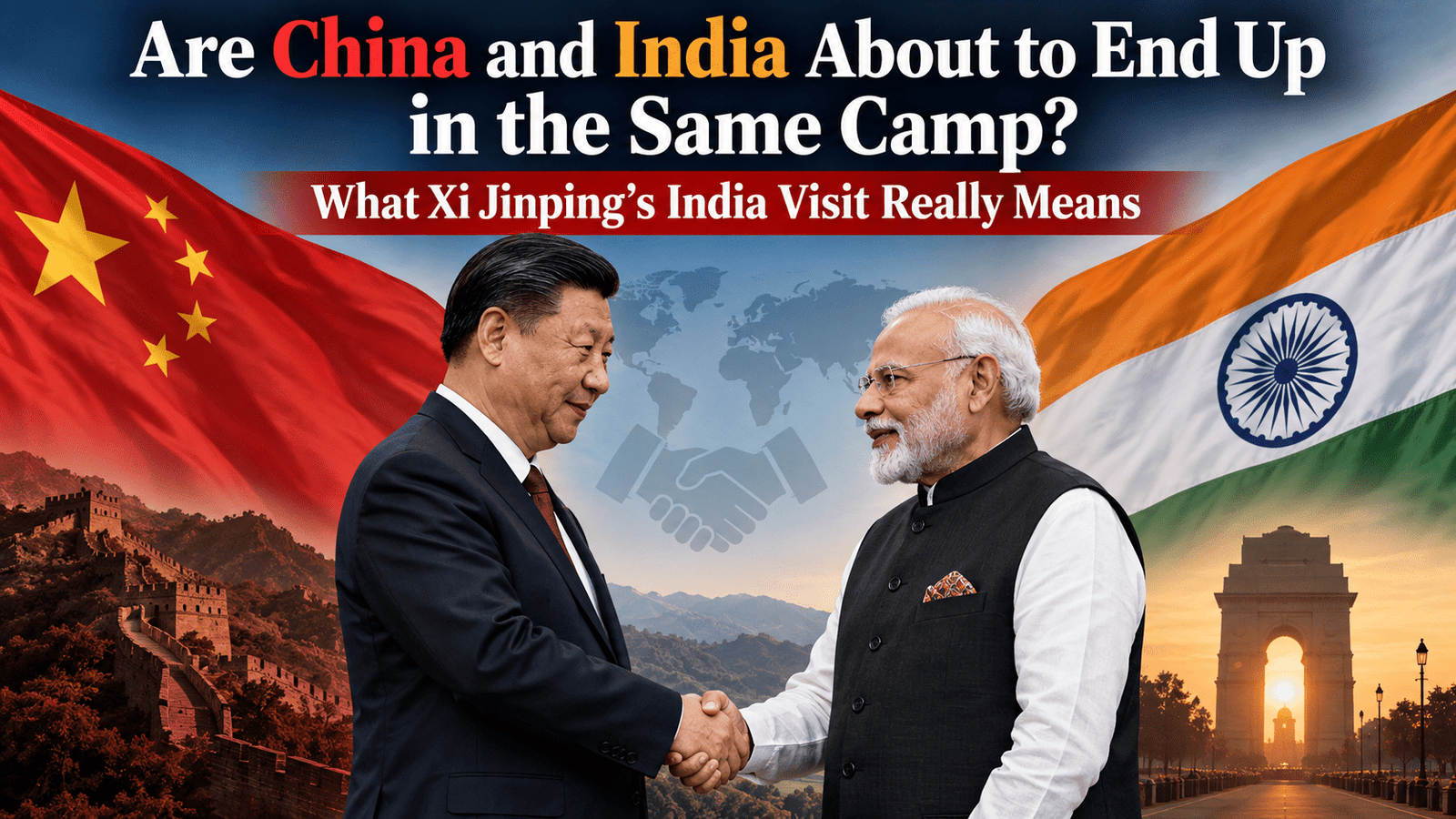
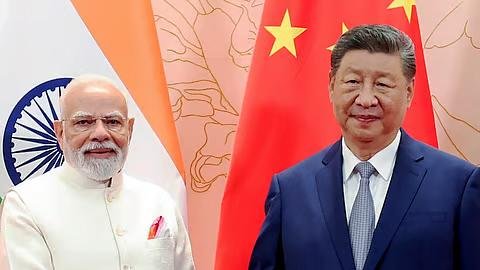
Xi Jinping’s return to India after seven years is one of the most closely watched diplomatic events of 2026. The Chinese president arrived in New Delhi on September 12 for the BRICS summit, where he is meeting Prime Minister Narendra Modi at a moment when India-China relations are simultaneously improving and remaining deeply competitive.
The obvious question is whether this marks the beginning of a genuine India-China strategic realignment.
The answer is more complicated.
India and China are not suddenly becoming allies. They continue to disagree over their disputed Himalayan boundary, remain competitors for influence across Asia, have sharply different relationships with Pakistan, and maintain fundamentally different strategic calculations regarding the United States.
Yet something important is changing.
After the devastating 2020 Galwan clash, both countries spent several years rebuilding military deployments, restricting economic engagement and allowing political trust to deteriorate. Today, there is a cautious attempt to stabilize the relationship.
Xi’s visit is therefore best understood not as the creation of a China-India alliance, but as a controlled attempt to prevent strategic competition from becoming permanent confrontation.
That distinction matters.
Xi Jinping’s Seven-Year Return to India
Xi Jinping last visited India in 2019, when he travelled to Mamallapuram, near Chennai, for an informal summit with Modi.
A year later, relations changed dramatically.
In June 2020, Indian and Chinese troops fought a deadly confrontation in the Galwan Valley in eastern Ladakh. Twenty Indian soldiers and four Chinese soldiers were killed, according to the figures publicly acknowledged by the two governments. The confrontation triggered a prolonged military crisis along the Line of Actual Control (LAC).

The consequences extended far beyond the battlefield.
India tightened scrutiny of Chinese investments, restricted several Chinese applications, tightened business-visa procedures and suspended direct passenger air connectivity. China, meanwhile, restricted various forms of people-to-people and business interaction.
For several years, the relationship effectively operated under a new formula:
Border tensions first, normal relations later.
Xi’s arrival in New Delhi seven years after his last visit therefore carries symbolic importance.
But the timing is equally significant.
India and China have already moved through several stages of cautious normalization. The two sides reached a disengagement agreement in October 2024, followed by the restoration of greater diplomatic and economic engagement. By 2025, Modi and Xi were holding substantive discussions again, including their August 2025 meeting on the sidelines of the Shanghai Cooperation Organisation summit in Tianjin.
Xi’s Delhi visit is the next stage of that process.
Is This a Strategic Reset—or Merely a Tactical Adjustment?
This is the central question.
It would be tempting to describe the Xi visit as a “reset” in India-China relations.
But that interpretation may go too far.
A genuine strategic reset would require the two countries to resolve—or at least substantially transform—the fundamental issues that have produced confrontation.
Those issues remain.
The boundary dispute has not disappeared. Military forces remain deployed in substantial numbers along the frontier. China and India continue to compete for influence across South Asia and the Indian Ocean. Beijing maintains a close strategic relationship with Pakistan, which remains one of India’s principal security concerns.
At the same time, India is strengthening partnerships with the United States, Japan, Australia and European countries.
China sees many of these relationships through the lens of strategic competition with Washington.
India does not.
New Delhi’s foreign policy is built around strategic autonomy: maintaining the freedom to cooperate with different powers without formally joining any geopolitical bloc.
This is why the phrase “same camp” can be misleading.
India may increasingly cooperate with China on selected global issues without becoming part of a China-led geopolitical bloc.
The Galwan Shadow Has Not Disappeared
Any analysis of the Modi-Xi relationship must begin with the border.
The 2020 Galwan confrontation destroyed much of the political trust accumulated over previous decades.
But Galwan was not an isolated event.
India-China border tensions have repeatedly appeared at different points along the LAC.
The Depsang crisis emerged in 2013.
The Doklam standoff took place in 2017.
Then came Galwan and the wider eastern Ladakh crisis in 2020.
The geographic problem is fundamental: India and China share a roughly 3,800-kilometre disputed Himalayan frontier that is not fully demarcated.
Consequently, even when troops disengage from a particular confrontation site, the underlying territorial disagreement remains.
This means that a stable India-China relationship cannot depend solely on political statements.
It requires a durable border-management mechanism.
The 2024 disengagement agreement was therefore important because it reduced the immediate military crisis. By the end of that process, the two countries had withdrawn troops from previously contested confrontation locations.
But disengagement is not the same as a final boundary settlement.
That distinction is crucial.
What Does India Actually Want?
India’s immediate objective is relatively straightforward:
No repeat of 2020.
New Delhi wants peace and predictability along the LAC so that the military does not have to remain permanently focused on the possibility of another confrontation.
It also wants diplomatic engagement to translate into practical economic benefits.
India has little incentive to permanently sever economic ties with the world’s second-largest economy.
But it also does not want economic dependence to become a strategic vulnerability.
That creates a difficult balancing act.
Trade: The Biggest Opportunity and the Biggest Problem
The economic relationship is perhaps the strongest argument for better India-China ties.
It is also one of the greatest sources of Indian concern.
In financial year 2025-26, bilateral goods trade reached approximately $151.1 billion. India’s exports to China rose to $19.47 billion, while imports reached $131.63 billion.
The result was an enormous Indian trade deficit of approximately $112.16 billion.
These figures reveal something important.
Despite political tensions, economic interdependence did not disappear after Galwan.
In fact, trade has continued to expand.
China has become India’s largest source of imports, supplying Indian industries with machinery, electronics, components, chemicals, batteries, computers and other critical inputs.
This creates a paradox.
India views China as a strategic competitor.
But Indian manufacturing also relies heavily on Chinese supply chains.
Therefore, completely decoupling from China would be enormously expensive.
The more realistic objective is de-risking rather than complete decoupling.
India wants greater domestic manufacturing capacity and diversified supply chains while continuing to access Chinese products where necessary.
China, meanwhile, has its own reason to improve economic ties.
Its economy depends heavily on manufacturing and exports. India represents one of the world’s largest and fastest-growing consumer and industrial markets.
For Beijing, a stable relationship with India creates commercial opportunities at a time when China is facing increasing trade and geopolitical pressure from the United States and parts of Europe.
The Trade Deficit Is the Real Test
The most important economic question for Xi and Modi is therefore not whether bilateral trade will increase.
It probably will.
The real question is:
Will the structure of that trade become more balanced?
India wants greater access to China’s enormous market, particularly for sectors in which Indian companies are internationally competitive.
These include pharmaceuticals, information technology, agriculture, chemicals and various industrial products.
India’s official position has repeatedly emphasized the need to address market-access barriers.
The problem is that greater Chinese exports to India are easier to achieve than greater Indian exports to China.
That imbalance is at the heart of the $112-billion deficit.
The Indian government has therefore sought greater market access and more balanced trade rather than simply larger trade volumes. India’s Embassy in Beijing describes the trade deficit as a major bilateral concern and says India continues to engage China on market-access issues.
Xi’s visit will therefore be judged partly by whether the two governments can translate political goodwill into concrete economic mechanisms.
Could Chinese Investment Return to India?
Investment is another sensitive issue.
After the 2020 crisis, India tightened scrutiny of Chinese investments, particularly in strategically sensitive sectors.
The logic was straightforward.
India did not want companies connected to a geopolitical competitor to gain excessive influence over critical infrastructure, telecommunications, finance, technology or other sensitive areas.
But there is also a practical consideration.
Chinese companies possess enormous manufacturing expertise and supply-chain capabilities.
If India wants to accelerate manufacturing, electric vehicles, electronics, batteries, solar equipment and industrial production, access to Chinese technology and components can be economically attractive.
The challenge is therefore not simply:
Chinese investment—yes or no?
The more sophisticated question is:
Which Chinese investment, under what conditions, in which sectors, and with what security safeguards?
That is likely to be one of the most important economic debates in the next phase of India-China relations.
Why China Needs India Too
For years, the relationship was often discussed as though India was the side seeking economic engagement while China held the stronger position.
That calculation is becoming more complicated.
China needs major external markets.
It also needs stable relationships with important developing economies.
India’s enormous consumer market makes it difficult for Beijing to ignore New Delhi.
Furthermore, India has increasingly demonstrated that it will not automatically align itself with Washington against Beijing.
India continues to maintain relationships with Russia, participates in BRICS and the Shanghai Cooperation Organisation, and insists on strategic autonomy.
From Beijing’s perspective, this creates space.
China may not be able to turn India into an ally.
But it can attempt to prevent India from becoming a committed adversary.
That is strategically valuable.
Why India Needs China
India’s calculations are equally pragmatic.
China remains a major economic power, a permanent member of the UN Security Council, a nuclear-armed state and one of the world’s largest manufacturing economies.
India cannot simply pretend China does not exist.
It needs to manage the relationship.
India also has an interest in avoiding simultaneous confrontation with multiple major powers.
Maintaining a relatively stable western border with Pakistan is already a major strategic requirement.
A permanent military crisis with China would force New Delhi to divide its resources across two fronts.
Therefore, reducing the probability of another India-China border crisis is in India’s strategic interest even if the larger competition remains unresolved.
This explains why stabilization can be valuable without reconciliation.
The China-Pakistan Factor
One of the biggest obstacles to deeper India-China trust is Beijing’s relationship with Pakistan.
China has invested heavily in Pakistan and maintains extensive defence cooperation with Islamabad.
From India’s perspective, China’s support for Pakistan becomes particularly sensitive during periods of India-Pakistan military tension.
The issue is not simply diplomatic.
It affects India’s threat perception.
Even if China and India improve their bilateral relationship, New Delhi will continue watching China’s military and strategic cooperation with Pakistan closely.
This makes a comprehensive strategic partnership between India and China difficult.
A country cannot easily build deep strategic trust with a state whose closest regional security partner is its principal military rival.
What Does BRICS Have to Do With It?
Xi’s visit is taking place during the 18th BRICS summit in New Delhi.
That is not a coincidence.
BRICS has evolved from a relatively small economic grouping into a much broader platform involving major emerging economies.
Its importance lies partly in its ability to provide a forum outside traditional Western-led institutions.
For both India and China, BRICS offers an opportunity to promote a more multipolar international order.
But even here, the two countries are not identical.
India does not want BRICS to become an anti-American alliance.
China is more comfortable with a framework that challenges aspects of US global influence.
India’s approach is therefore more flexible:
cooperate where interests overlap, resist bloc politics where strategic autonomy is threatened.
That is why Modi can stand alongside Xi and Vladimir Putin in BRICS while simultaneously maintaining extensive engagement with the United States, Europe, Japan and other partners.
The United States Is an Important Part of the Equation
It is impossible to understand the recent India-China thaw without considering Washington.
US-China relations remain deeply competitive.
Trade restrictions, technology controls, supply-chain disputes and geopolitical disagreements have created pressure on Beijing.
India, meanwhile, has developed a much closer relationship with the United States over the past decade.
That relationship encompasses defence, technology, trade, critical minerals, maritime security and the Indo-Pacific.
Yet India has never accepted the idea that it must choose permanently between Washington and Beijing.
This is where strategic autonomy becomes particularly important.
If US-China competition intensifies, India may actually have an incentive to maintain better relations with China—not because India trusts Beijing completely, but because New Delhi does not want to become dependent on any single external power.
The same calculation applies in reverse.
China may want to prevent India from becoming a full strategic extension of US power in Asia.
This creates an unusual convergence:
Both India and China have reasons to reduce unnecessary confrontation even while they remain competitors.
Are India and China Moving Into the Same Camp?
Not exactly.
They are moving toward greater tactical coordination in selected areas.
That is different from strategic alignment.
India and China may cooperate on:
- BRICS and other multilateral forums
- Reform of global institutions
- Developing-country interests
- Energy and economic stability
- Global trade issues
- Selected diplomatic questions
- Maintaining a multipolar international system
But they will continue to compete over:
- The Himalayan boundary
- Arunachal Pradesh
- Indian Ocean influence
- South Asian geopolitics
- Technology
- Manufacturing
- Supply chains
- Pakistan
- Regional military power
- Relations with the United States
Therefore, the phrase “same camp” should be used carefully.
They may increasingly find themselves on the same side of particular issues without becoming members of the same geopolitical camp.
The Most Important Word: Predictability
The biggest outcome of Xi’s visit may not be a dramatic agreement.
It may be something less visible but more important:
predictability.
If India and China can establish a pattern in which border disputes are managed through military and diplomatic channels, trade continues despite disagreements, leaders communicate regularly and crises do not automatically escalate, the strategic environment changes significantly.
That alone would be a major achievement.
Diplomacy does not always produce historic treaties.
Sometimes its greatest success is preventing the next crisis.
What Concrete Outcomes Should We Watch For?
The Modi-Xi meeting should be evaluated against practical indicators rather than photographs and statements.
1. Border mechanisms
Will the two governments announce additional confidence-building measures?
Will military commanders receive stronger communication mechanisms?
Will the Special Representatives’ boundary talks make meaningful progress?
2. Trade
Will China offer greater market access to Indian products?
Will both sides establish mechanisms to address the massive trade imbalance?
3. Investment
Will India further ease restrictions on Chinese investment in selected non-sensitive sectors?
Will China encourage companies to invest in India under Indian regulatory requirements?
4. Connectivity
Will direct flights and visa facilitation continue expanding?
Will people-to-people exchanges return closer to pre-2020 levels?
5. Economic dialogue
Will India and China create a more institutionalized mechanism to address trade, investment, technology and supply-chain concerns?
These indicators will tell us much more about the future than diplomatic language alone.
What Xi’s Visit Does—and Does Not—Mean
Xi Jinping’s return to India is undoubtedly significant.
It would have been difficult to imagine such a visit during the worst period of the post-Galwan crisis.
The fact that Xi is personally attending the BRICS summit in New Delhi demonstrates that both governments believe the relationship has moved beyond the immediate crisis-management phase.
But it would be premature to declare the relationship transformed.
The border remains unresolved.
Strategic distrust remains.
The trade deficit remains enormous.
China’s relationship with Pakistan remains a major Indian concern.
India’s relationship with the United States remains strategically important.
And the two countries remain competitors for influence across Asia.
The more accurate description is therefore:
India and China are moving from confrontation management toward competitive coexistence.
That may sound less dramatic than a “strategic reset.”
But it is arguably more realistic.
Conclusion: Not Allies, Not Enemies—But Pragmatic Competitors
So, are China and India about to end up in the same camp?
Probably not.
At least not in the traditional sense of the word.
India is unlikely to abandon strategic partnerships with the United States, Europe, Japan and other Indo-Pacific countries. China is unlikely to fundamentally change its relationship with Pakistan or abandon its territorial claims.
At the same time, neither country has an interest in allowing relations to return to the dangerous instability of 2020.
That creates a narrow but important space for cooperation.
Xi’s 2026 visit should therefore be understood as an attempt to institutionalize stability without resolving competition.
For India, the objective is to protect the border, reduce the risk of another military crisis, obtain better economic access and preserve strategic autonomy.
For China, the objective is to stabilize relations with a major Asian power, protect access to the Indian market, avoid pushing India deeper into the US strategic orbit and strengthen the credibility of BRICS.
Those interests overlap—but they do not completely converge.
And that is precisely why the coming months will matter.
If Xi’s visit produces stronger border-management mechanisms, meaningful economic commitments, improved connectivity and sustained political dialogue, it could mark the beginning of a durable new phase.
If the visit produces only diplomatic symbolism without progress on the underlying disputes, the thaw could remain fragile.
The real test will come after the red carpets disappear.
Can India and China build enough trust to manage their disagreements without allowing competition to become conflict?
That is the question that will determine whether Xi Jinping’s return to Delhi becomes a historic turning point—or simply another temporary pause in one of Asia’s most consequential rivalries.
Frequently Asked Questions
1. Why is Xi Jinping visiting India in 2026?
Xi Jinping is visiting New Delhi on September 12–13, 2026, to attend the BRICS summit and hold talks with Prime Minister Narendra Modi. It is his first visit to India since 2019. The visit comes after several years of severe India-China tensions following the 2020 Galwan clash.
2. Is India becoming an ally of China?
No. There is currently no evidence of an India-China alliance. Both countries continue to have major strategic disagreements. India is pursuing strategic autonomy and maintains relationships with the United States, Russia, Europe, Japan and other major powers.
3. What happened during the Galwan clash?
Indian and Chinese troops fought a deadly confrontation in the Galwan Valley in June 2020. Twenty Indian soldiers and four Chinese soldiers were killed, according to the figures acknowledged by the two governments. The confrontation triggered a prolonged military crisis along the disputed Himalayan border.
4. Has the India-China border dispute been resolved?
No. The two countries reached a disengagement agreement in 2024 that reduced the immediate military confrontation at several locations, but the larger boundary dispute remains unresolved. Both countries continue to maintain significant military capabilities along the frontier.
5. How much does India trade with China?
Goods trade between India and China reached approximately $151.1 billion in financial year 2025-26. India’s exports to China were about $19.47 billion, while imports were approximately $131.63 billion, producing a trade deficit of around $112.16 billion.
6. Why is India’s trade deficit with China a concern?
India imports substantially more from China than it exports there. Chinese machinery, electronics, components, chemicals and other industrial goods are important to Indian manufacturing, while Indian companies face challenges expanding exports into the Chinese market. New Delhi therefore wants greater market access and a more balanced trade relationship.
7. Why is China important to India despite political tensions?
China is one of the world’s largest economies and a major source of industrial goods, machinery, electronics and components. Completely eliminating economic ties would be extremely costly for Indian businesses and consumers. India therefore increasingly seeks to reduce excessive dependence while maintaining economically useful trade.
8. Why does China want better relations with India?
China has strong economic and geopolitical reasons to stabilize ties. India is one of the world’s largest markets, while Beijing also has an interest in preventing India from becoming a permanent strategic adversary or aligning completely with US efforts to contain Chinese influence.
9. Does India’s relationship with the United States prevent better relations with China?
Not necessarily. India follows a policy of strategic autonomy. It can cooperate closely with Washington in defence, technology and the Indo-Pacific while simultaneously maintaining economic and diplomatic engagement with Beijing.
10. What is the biggest obstacle to India-China relations?
The unresolved boundary dispute remains one of the biggest obstacles. Other major problems include China’s relationship with Pakistan, military deployments along the LAC, the trade imbalance, technology competition and mutual strategic distrust.
11. Could India and China cooperate more through BRICS?
Yes. BRICS provides a platform where India and China can cooperate on selected issues involving global governance, developing-country interests, trade and multipolarity. However, their cooperation inside BRICS does not mean that their broader strategic interests are identical.
12. What would make Xi’s 2026 India visit a real success?
The strongest evidence would be concrete progress rather than symbolism: additional border confidence-building measures, improved military communication, greater market access for Indian exports, progress on trade and investment, expanded connectivity and sustained high-level diplomatic engagement.
13. Is Xi’s visit a “strategic reset”?
It is safer to describe the current phase as stabilization or cautious normalization rather than a complete strategic reset. The relationship has improved from the post-2020 crisis, but fundamental disagreements remain unresolved.
14. What should India watch after Xi leaves?
India should watch whether the diplomatic momentum survives beyond the summit. The most important indicators will be border stability, trade negotiations, Chinese market access for Indian companies, investment rules, visa and flight connectivity, and the continuation of military and diplomatic dialogue.