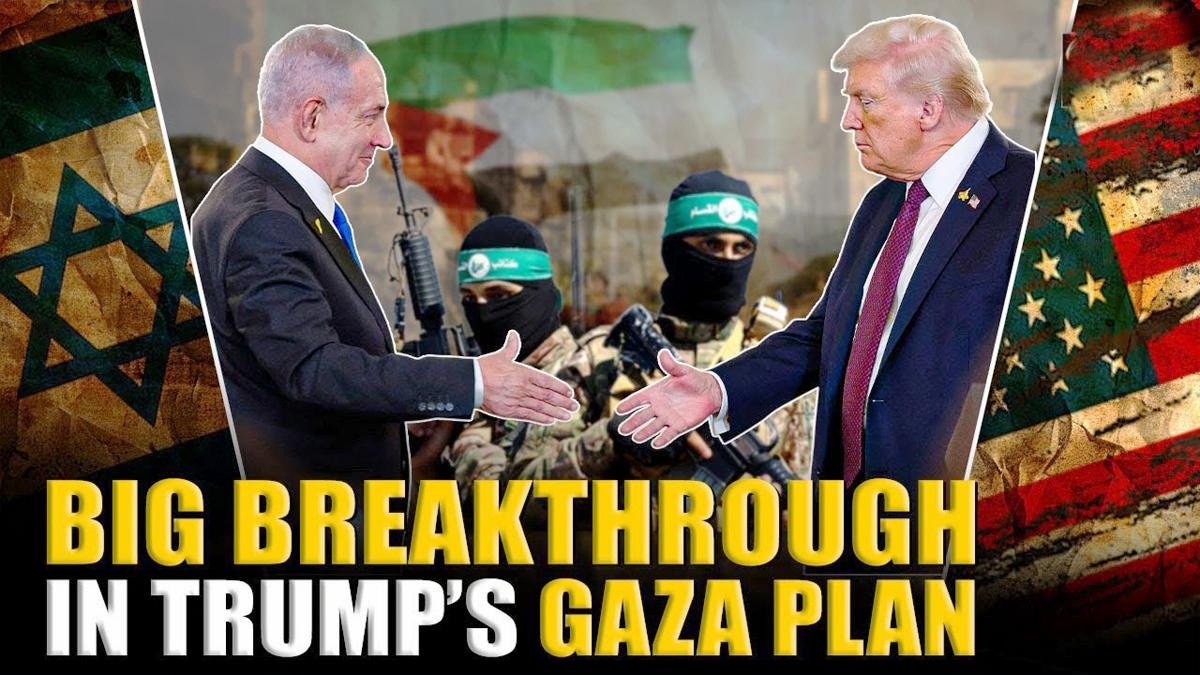
U.S. President Donald Trump has made a major announcement concerning Hamas in Gaza laying down its weapons. A Hamas official has confirmed the agreement in a conversation with the BBC. However, Israel has not yet issued an official response.
President Donald Trump said that the Board of Peace has reached an agreement under which Hamas and other armed groups in Gaza will completely disarm. A senior Hamas official confirmed the agreement to the BBC, stating that the organization has agreed to the Board of Peace’s plan for complete disarmament in Gaza and that an official statement will be released soon.
The senior Hamas official, who is also a member of the negotiation team, told the BBC that the talks were long and extremely difficult. Hamas insisted that its weapons should not be handed over directly to Israel. Instead, the weapons would be inventoried and securely stored under Palestinian supervision.
So far, Israel has not commented on the agreement. Meanwhile, the Board of Peace has described it as a historic achievement. The second phase of the Gaza Peace Plan, prepared through U.S. mediation, includes Hamas disarming and the reconstruction of Gaza.
Following the agreement, President Trump posted on Truth Social:
“This agreement will be implemented carefully. As the process moves forward, Israeli forces will withdraw, and an international stabilization force, together with a new Palestinian police force, will take responsibility for ensuring that Gaza is safe for its people and neighboring countries.”Trump also thanked Egypt, Qatar, and Turkey for their mediation efforts. The Board of Peace stated that the agreement is the result of months of intensive and sincere negotiations aimed at advancing President Trump’s vision for Gaza. According to the Board, this vision seeks to establish a new governing system, improve security, provide humanitarian relief, rebuild Gaza, and revive its economy.
The Board added that the agreement promises significant benefits for the people of Gaza. It described the roadmap as a historic breakthrough, saying that, for the first time, Hamas has officially agreed to an implementable plan to completely dismantle its weapons infrastructure. In return, Israel would withdraw its military forces from Gaza.
The Board concluded by saying that its immediate focus is now on implementing the agreement. According to AFP, citing Egyptian state media, mediators will meet in Cairo to discuss the second phase of the ceasefire plan.
Israel’s Position Remains Unclear
The key question remains Israel’s response. After Trump’s announcement, The Times of Israel, citing a source, reported that Hamas negotiators, the Board of Peace, and representatives of the mediating countries had signed the agreement. However, the newspaper also reported that an Israeli official said the disarmament proposal does not satisfy Israel’s security demands. Israeli media had previously reported that Israel opposed the agreement being discussed with Hamas.
U.S. Officials Warn Israel
U.S. officials also commented on Israel’s position. They said that President Trump would be “very disappointed” if Israel failed to honor the agreement.
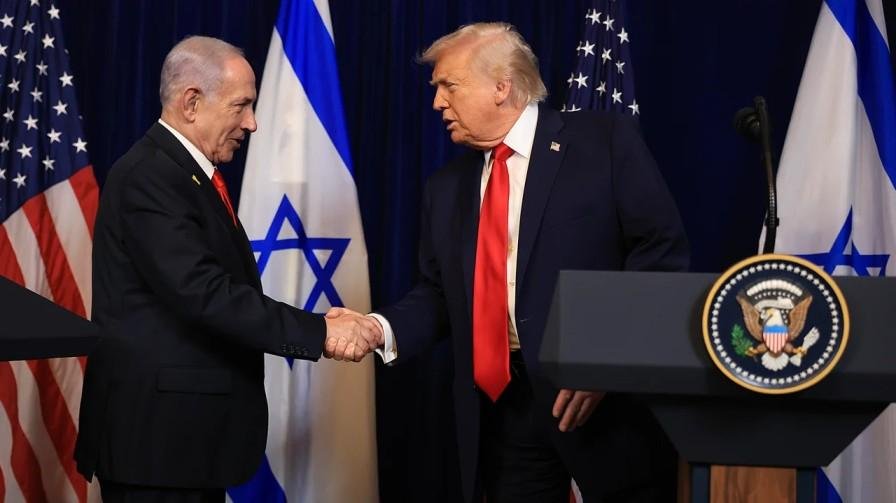
When asked how concerned they were about Israel withdrawing from Gaza after Hamas disarms, one U.S. official replied: “We are simply asking Israel to follow the 20-point plan that it initially agreed to. We are confident that it will do so.”The official added that if Israel does not withdraw in accordance with the plan, Trump would be very disappointed. He also expressed confidence that Israel would continue to be a strong partner of the United States.
Nevertheless, uncertainty remains because Israeli military operations reportedly continued even after the ceasefire agreement.
Progress Has Been Limited
Although six months have passed since the second phase of the ceasefire began, little progress has reportedly been made.
According to the Hamas-run Health Ministry in Gaza, at least 1,168 Palestinians have been killed in Israeli attacks since the ceasefire came into effect last October. During the same period, four Israeli soldiers were reportedly killed in attacks originating from Gaza.Background
Last October, President Trump proposed a 20-point peace plan aimed at ending the conflict between Israel and Hamas.
The plan included:
- A ceasefire between Israel and Hamas.
- The release of Israeli hostages taken during the October 7, 2023 attack.
- The complete disarmament of Hamas.
- The full withdrawal of Israeli forces from Gaza.
The Board of Peace was established as part of this initiative.
What Challenges Is Saudi Arabia Facing Amid the US-Iran Conflict?
Ever since the United States and Israel launched military operations against Iran on 28 February, Saudi Arabia has tried to stay largely out of the conflict.
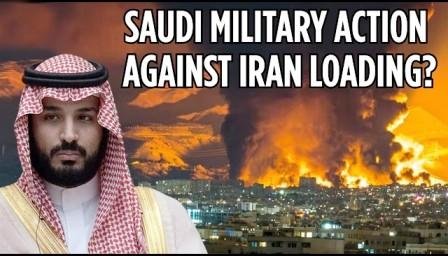
However, after coming under attacks from three different directions, Saudi Arabia’s patience appears to have run out. This week, Saudi Arabia joined the United States in conducting joint strikes against Iranian proxy militias in Iraq. Saudi Arabia believes these militias were responsible for the drone attacks targeting the Kingdom.
Saudi Arabia now faces a difficult choice: whether to continue retaliatory military action or attempt to reduce tensions.
Why Saudi Arabia Wants to Stay Out of the Conflict
There are several reasons why Saudi Arabia is trying to avoid becoming fully involved in the war.
Crown Prince Mohammed bin Salman has been pursuing the country’s Vision 2030 strategy. The goal is to diversify Saudi Arabia’s economy beyond oil by developing modern industries that can provide better jobs for young people. A major part of Vision 2030 is attracting foreign investment. However, if Saudi Arabia continues to face drone attacks from the Houthis in Yemen or direct ballistic missile attacks from Iran, those ambitions could be seriously undermined.
Lessons from the 2019 Drone Attack
In September 2019, Saudi Arabia suffered a major setback. During a period of heightened tensions with Iran, Iranian-backed militias in Iraq allegedly carried out drone attacks on Saudi Arabia’s two most important oil facilities—Abqaiq and Khurais. Those attacks temporarily disrupted nearly half of Saudi Arabia’s oil exports for several days. For Saudi Arabia, this served as a warning that its critical infrastructure was highly vulnerable to such attacks.
Recent satellite imagery reportedly indicates that the Abqaiq oil facility has once again been targeted by drone strikes. These attacks are also believed to have been carried out by Iranian-backed militias based in Iraq.
Oil Remains the Backbone of Saudi Arabia’s Economy
Oil continues to be Saudi Arabia’s greatest economic strength.
In response to the U.S. and Israeli attacks in February, Iran retaliated by effectively disrupting shipping through the Strait of Hormuz, a strategically important waterway between Iran and the Gulf states. Nearly 20% of the world’s oil and liquefied natural gas (LNG) passes through this route. To reduce the impact, Saudi Arabia transported as much oil as possible—around 5 million barrels per day—through its East-West Pipeline to its export terminal at Yanbu on the Red Sea. From there, oil was loaded onto tankers and shipped south through the Red Sea toward Asian markets. Initially, this alternative route worked.
New Threats from Yemen
However, on 13 July, Saudi Arabia reportedly carried out airstrikes in Yemen. In response, Houthi rebels launched attacks on Saudi Arabia’s Abha and Jizan airports. Saudi Arabia is also increasingly concerned because the Houthis have begun targeting Saudi vessels in the Red Sea. As a result, the Bab el-Mandeb Strait, located at the southern entrance to the Red Sea, has become much more dangerous for shipping. This threatens Saudi Arabia’s oil exports to Asia.
Pressure from Both North and South
Saudi Arabia spent seven years trying to defeat the Houthi movement through sustained airstrikes but failed to achieve its objectives. In 2022, Saudi Arabia eventually agreed to a difficult ceasefire and understanding with the Houthis. Now, however, the region’s wealthiest country is once again under pressure.
- From the south, it faces drone and missile attacks from the Houthis in Yemen.
- From the north, it faces attacks allegedly carried out by Iranian-backed militias operating from Iraq.
- When Saudi Arabia designed its Vision 2030 development strategy, it had not anticipated facing simultaneous security threats from multiple directions.
Chinese missiles filled with water; military and weaponry untested in war. The Chinese Army turns 99: the full story of its strengths and hollow spots.
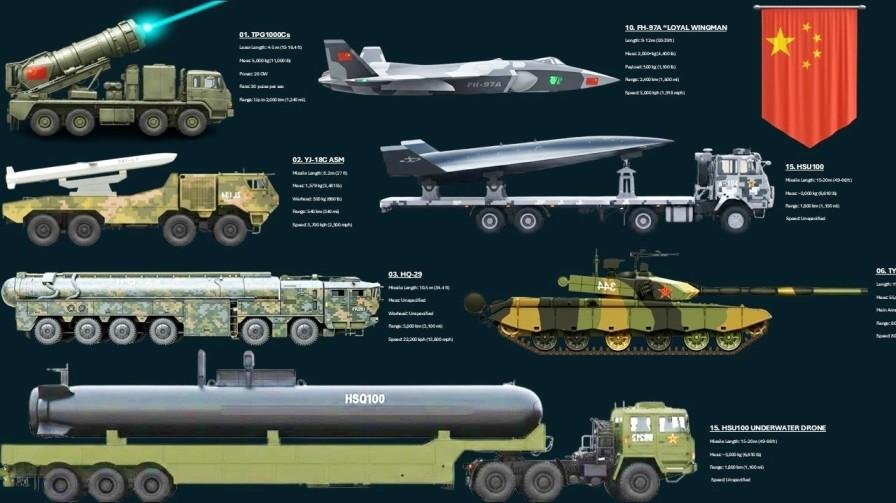
On August 1, 1927, a small force of workers and peasants was formed in China. It was poorly equipped and modest in size, but 99 years later, it has grown into what is often ranked as the world’s third-most-powerful military. Today, it possesses hypersonic missiles, around 2 million active personnel, and has pursued the goal of becoming one of the world’s most modern armed forces.
This is the story of the People’s Liberation Army (PLA). But an important question remains: Is its strength real, or is it largely for show? After all, China has not fought a major war in 47 years, and critics argue that its military has yet to prove itself in combat.
The PLA initially developed with significant assistance from the Soviet Union, which provided weapons, military training, and scientific expertise. Over time, China began manufacturing its own fighter aircraft. In 1964, it successfully tested its first nuclear bomb, followed by its hydrogen bomb in 1967.
The 1990s brought three major shocks that deeply influenced China’s military strategy.
• In 1991, during the Gulf War, the United States quickly destroyed Iraq’s Soviet-built military systems, demonstrating the overwhelming effectiveness of modern American warfare.
• In 1996, during the Taiwan Strait Crisis, China conducted missile tests near Taiwan. In response, the United States deployed two aircraft carrier strike groups, and China was unable to challenge them.
• In 1999, during the NATO bombing campaign in Yugoslavia, the Chinese embassy in Belgrade was accidentally bombed by the United States. China could do little beyond protesting the incident.
Following these events, China accelerated military modernization. It studied foreign technology, reverse-engineered equipment, and developed its own advanced weapons.
Today, the PLA reportedly has more than 370 warships and submarines, the J-20 stealth fighter, and the DF-17 hypersonic missile system. Between 2020 and 2025, China’s inventory of ballistic and cruise missiles is reported to have grown significantly. However, the real question remains: How much of this strength translates into actual battlefield capability?
China last fought a major war in 1979, against Vietnam. Since then, it has not participated in a full-scale war. According to a report by the RAND Corporation, some critics claim that Chinese soldiers spend a significant amount of time studying Communist Party ideology, leaving less time for realistic combat training. The report also argues that military exercises are often designed to meet political objectives rather than simulate real battlefield conditions.
Another frequently cited example comes from a 2016 UN peacekeeping mission in South Sudan, where some reports alleged that Chinese peacekeepers abandoned weapons and retreated during an attack. (This account is disputed and has been debated.)
In 2024, Bloomberg, citing U.S. intelligence sources, reported allegations that some Chinese missile silos contained missiles with fuel tanks filled with water rather than fuel, and that certain underground missile silo lids were so poorly constructed that they might fail to open during an emergency. These allegations have not been independently verified.
Pakistan and Myanmar have also reportedly faced operational issues with some Chinese-made JF-17 fighter jets, leading to criticism over reliability. According to a report presented to the U.S. Congress, citing French intelligence, China allegedly used edited images of damaged Rafale fighter jets and even video game footage on social media to portray its own military equipment as battle-tested. These claims remain contested. A major concern frequently raised is corruption. Between 2022 and 2026, more than 100 senior military officials were reportedly removed, dismissed, or disappeared amid anti-corruption investigations. Among them were former defense ministers, vice chairmen of the Central Military Commission, and senior commanders of the Rocket Force. Unlike many other militaries, the PLA’s primary mission is not only national defense but also maintaining the leadership of the Chinese Communist Party. Loyalty to the Party remains a core principle of the force. As a result, one question continues to be debated: Is China’s military truly as strong as it appears from the outside, or does its lack of combat experience and internal challenges make it less capable than its impressive arsenal suggests?
Pakistan, Saudi Arabia and Turkey’s New Defense Pact: Could It Shift the Balance in the Middle East and Raise Concerns for India?
Saudi Arabia, Pakistan, and Turkey have signed the “Mecca Joint Defense Agreement.” The agreement could potentially alter the strategic balance in the Middle East. Experts explain what this development could mean for India.
Amid rising tensions in the Middle East, Pakistan Prime Minister Shehbaz Sharif and Turkish President Recep Tayyip Erdoğan travelled to Saudi Arabia, where they met Saudi Crown Prince Mohammed bin Salman. The three leaders signed the Mecca agreement. According to a statement issued by Pakistan’s Foreign Ministry, the agreement states that an attack on any one of the three countries will be considered an attack on all three, and the countries will take necessary steps to protect one another.
The three countries bring different strategic strengths to the partnership. Saudi Arabia has significant financial and economic power; Pakistan has nuclear weapons, ballistic missiles, and substantial military manpower; while Turkey has considerable military experience and a strong defense industry. Together, these capabilities could lead to the emergence of a new power equation in the Middle East.
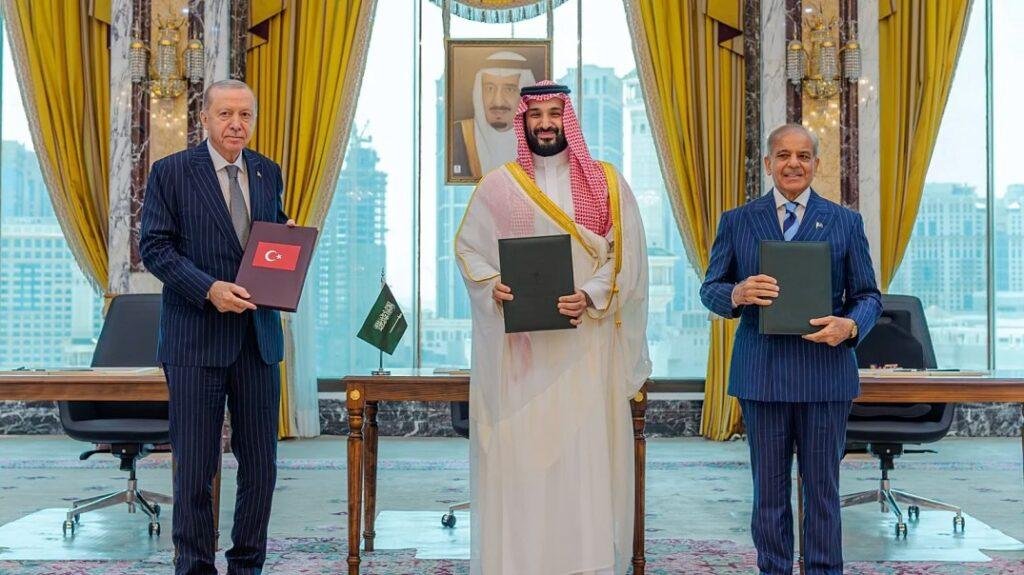
Pakistan’s Prime Minister Shehbaz Sharif was accompanied on the visit by Pakistan’s military chief, Field Marshal Asim Munir, along with a senior delegation.
Pakistan is also attempting to strengthen its role in the region. On the one hand, Islamabad has sought to play a mediating role between Iran and the United States, while on the other, it is deepening its strategic relationships with Saudi Arabia and Turkey. This highlights the growing importance of Pakistan’s position in the region. According to BBC correspondent Sharif Turtdin Raja Vardaman, Shehbaz Sharif, Recep Tayyip Erdoğan, and Crown Prince Mohammed bin Salman signed the agreement after attending a joint defense summit in Mecca.Under the agreement, an attack on any one of the three countries will be treated as an attack on all three.Saudi Arabia’s official news agency, the Saudi Press Agency, also released a statement broadly consistent with the Pakistani Foreign Ministry’s announcement. According to Pakistan’s Foreign Office, the purpose of the agreement is to strengthen collective deterrence against any act of aggression. It establishes that any armed attack against one of the three countries will be considered an attack against all three.
The agreement is also intended to strengthen defense cooperation among the three countries.
The meeting and agreement come at a time when tensions in the Middle East are extremely high. Security concerns surrounding commercial shipping routes in the Red Sea and the Strait of Hormuz, continuing uncertainty linked to Yemen, and the effects of the recent US-Iran conflict have encouraged regional powers to coordinate more closely on security matters.Experts point out that each of the three countries possesses significant strategic capabilities.Saudi Arabia is a major economic power. Turkey has extensive military experience and a strong defense industry, including defense technology and weapons production. Pakistan, meanwhile, has one of the region’s largest armed forces and is the only nuclear-armed state among the three. Analysts believe that the agreement could further strengthen Pakistan’s strategic relationships with both Riyadh and Ankara. Pakistan already has a mutual defense relationship with Saudi Arabia, but this new arrangement could expand the framework of regional cooperation. Pakistan’s Prime Minister had arrived in Saudi Arabia the previous evening. Around the same time, Indian Prime Minister Narendra Modi was also holding talks with Israeli Prime Minister Benjamin Netanyahu.India and Pakistan have very different positions on the Middle East. India maintains close relations with Israel, while Pakistan does not recognize Israel. Some analysts also view Pakistan’s close relationship with Turkey as a potential concern for India.So, does this new defense pact between Pakistan, Turkey, and Saudi Arabia represent a cause for concern for India? According to a professor of international affairs and regional politics, the agreement could present a challenge for India, particularly if the arrangement is eventually used against Indian interests. However, the expert argues that India should engage directly with Saudi Arabia and Turkey and make efforts to ensure that the alliance is not directed against India.India’s relationship with Saudi Arabia has become significantly stronger and more reliable over the past two decades. Therefore, Saudi Arabia could be an important channel for India to communicate its concerns.
The expert suggests that India should hold discussions with Saudi Arabia and seek clear assurances that the new defense arrangement will not be used against India.If India begins such a dialogue at an early stage, there is a reasonable possibility that it could obtain sufficient assurances from Riyadh. There is another important dimension to the issue. Saudi Arabia and Turkey may expect India to use its close relationship with Israel to encourage Israel to establish and respect clearly defined borders and avoid further territorial expansion. India’s official position on the issue is broadly consistent with the principle of respecting internationally recognized borders. However, there has been some uncertainty because of what critics perceive as limited public criticism by the Indian government of Israel’s actions and territorial policies in recent years. This has sometimes created the impression that India may be relatively sympathetic toward Israel’s position, although the expert argues that this is not necessarily the case.
According to the expert, if India continues its relationship with Israel while also taking greater account of the Palestinian issue, Saudi Arabia is likely to remain supportive of India and its broader relationship with the Gulf region. Overall, the new Saudi-Pakistan-Turkey defense agreement represents an important development in the evolving security architecture of the Middle East. While it does not necessarily mean that the alliance is directed against India, New Delhi will need to closely monitor how the agreement develops and engage diplomatically with Riyadh and Ankara to ensure that its strategic interests are protected.
Why did a US lawmaker describe this Indian bill regarding foreign funding as an ‘attack on Christians’?
The Monsoon Session of Parliament is underway, and a bill concerning foreign funding—specifically, the proposed amendments to the FCRA—is being hotly debated. While India’s opposition parties are voicing their views on the matter, the issue has also sparked discussion in the United States; in fact, a US lawmaker has even termed it an ‘attack on Christians.’ It is interesting to note that this bill is being discussed not only in India but also in the US. So, what exactly is this FCRA bill? What will happen if the proposed amendments are implemented, and why has a US lawmaker raised questions about it?
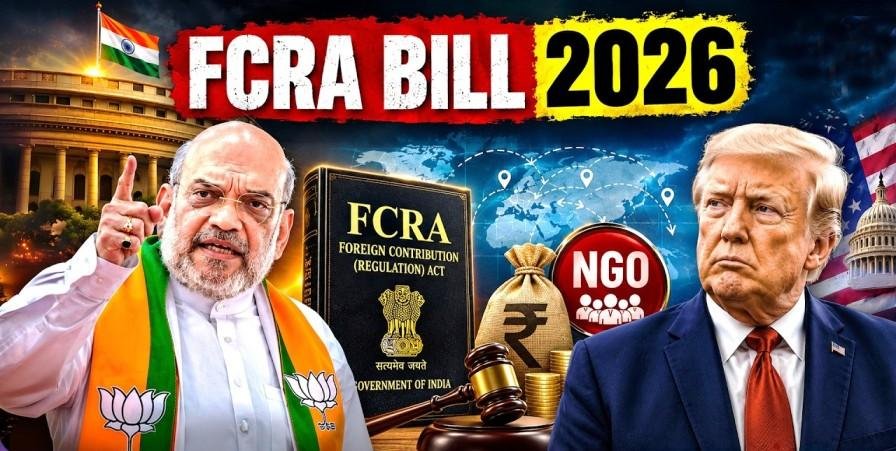
FCRA stands for the Foreign Contribution (Regulation) Act. This law regulates foreign donations received by non-governmental organizations (NGOs), civil society groups, educational institutions, and religious organizations. US Congressman Ralph Norman has described the proposed amendments to the FCRA as an attack on Christians and identified them as a major concern for India-US relations. He wrote that despite the long history of Christianity in India, the Indian Parliament is considering amendments to the FCRA rules that could place control over religious charities and organizations in the government’s hands. He termed this a clear attack on Christians and stated that if the bill proceeds in its current form, it would become a significant concern for bilateral relations with India. Responding to Ralph Norman’s statement, Ministry of External Affairs spokesperson Randhir Jaiswal said that legislative matters are internal affairs to be decided by the Parliament. He added that many countries worldwide, including the US, regulate foreign funding. The FCRA amendment bill has sparked considerable controversy; the opposition and various NGOs argue that certain provisions could grant excessive power to the central government. When the bill was first introduced during the Budget Session, Christian organizations across the country—including in Kerala—opposed it. At that time, the Minister of Parliamentary Affairs stated that the bill was introduced to strengthen national security and was not intended to target any specific religion. Conversely, opposition parties argued that it would grant the central government unlimited authority, leading the government to put the bill on hold. Now, Mizoram Chief Minister Lalduhoma has announced that the bill will be tabled in Parliament on August 12. The ‘Statement of Objects and Reasons’ attached to the bill notes that the amendments aim to address legal and administrative loopholes regarding the management of foreign contributions and assets created from them. According to PRS Legislative Research, the proposed amendments include a provision requiring organizations to renew their registration periodically. If an organization fails to apply for renewal on time or its application is rejected, its registration will lapse; under the proposed amendment, organizations whose FCRA registration is cancelled
The powers of the government authority overseeing their assets are set to be expanded; according to the bill, a new chapter has been added for this purpose. Under this provision, the central government will appoint an authority responsible for managing assets acquired—either wholly or partially—using foreign contributions. The amendment also stipulates that if an organization’s FCRA registration lapses, it will be barred from receiving or utilizing foreign contributions until registration is restored. Under the FCRA 2010, certain categories of persons—including election candidates, political parties, judges, MPs, MLAs, and media personnel—were already prohibited from accepting foreign contributions; subsequent amendments extended this ban to entities and companies involved in producing or broadcasting news and current affairs programs. The new bill extends this restriction to individuals associated with such activities. However, the bill offers some relief: it proposes reducing the maximum penalty for violating the law from five years to one year. Additionally, any person dissatisfied with the designated authority’s decision may appeal to the District Judge’s court within 90 days. Under the proposed law, organizations must obtain approval from the central government before making any decisions regarding assets created with foreign contributions.
2 thoughts on “Trump Makes Major Announcement Regarding Hamas in Gaza; What Is Israel’s Position?”