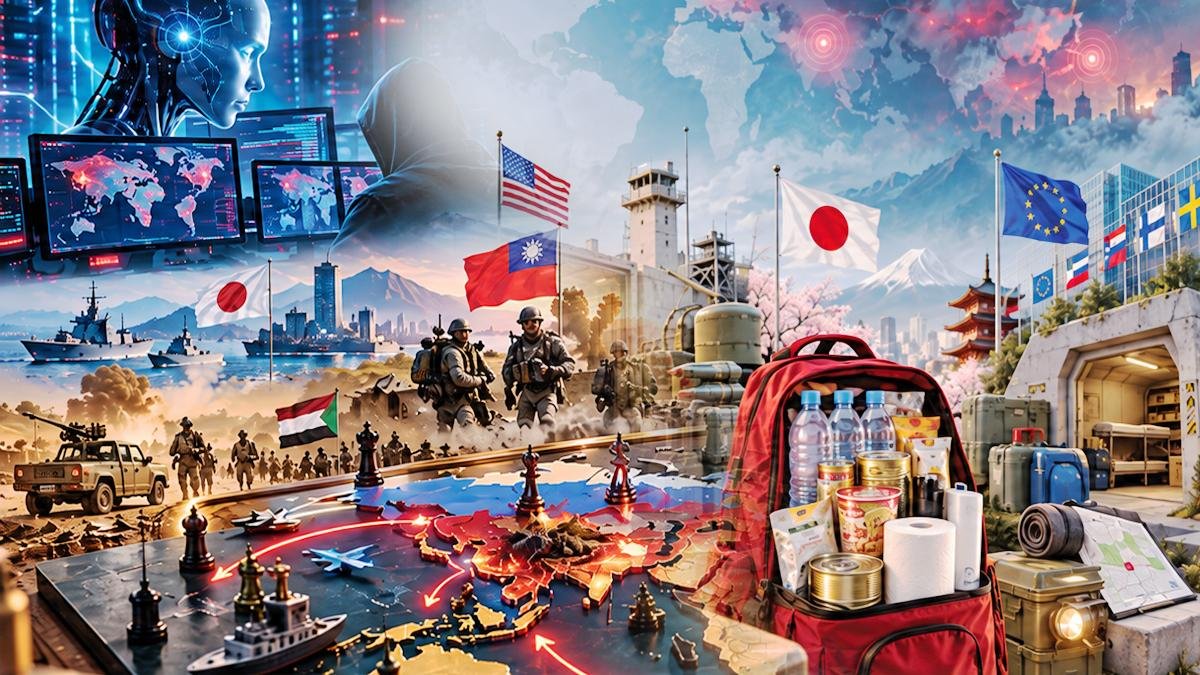
Governments around the world are taking emergency preparedness more seriously. From the United States and the United Kingdom to Japan and several European countries, authorities are encouraging people to keep essential supplies such as food, drinking water, medicines, batteries, and hygiene products at home.But why is this happening? Are governments preparing for a major global war, or are they simply trying to protect citizens from unexpected emergencies?
The discussion has become more serious in October 2026, especially after Britain’s new Be Ready campaign and reports about increased military preparations in the United States.Some commentators have also mentioned a possible “1,000-day countdown” towards 2030. However, there is an important difference between preparing for possible threats and knowing that a major war is coming.Let’s examine the facts, the international situation, and what these preparations really mean.
Why Are Governments Asking People to Stock Up on Emergency Supplies?
Modern societies depend heavily on electricity, internet connections, transportation networks, banking systems, and international supply chains.If any of these systems suddenly stop working, people may struggle to access basic necessities.For example, a major power outage could affect supermarkets, hospitals, ATMs, water supplies, and communication networks. Similarly, cyberattacks or severe weather could interrupt transportation and food deliveries.Governments want households to manage independently for a short period while emergency services restore essential facilities.This is the main reason behind the growing focus on emergency preparedness.
1. United Kingdom Launches Its Be Ready Campaign
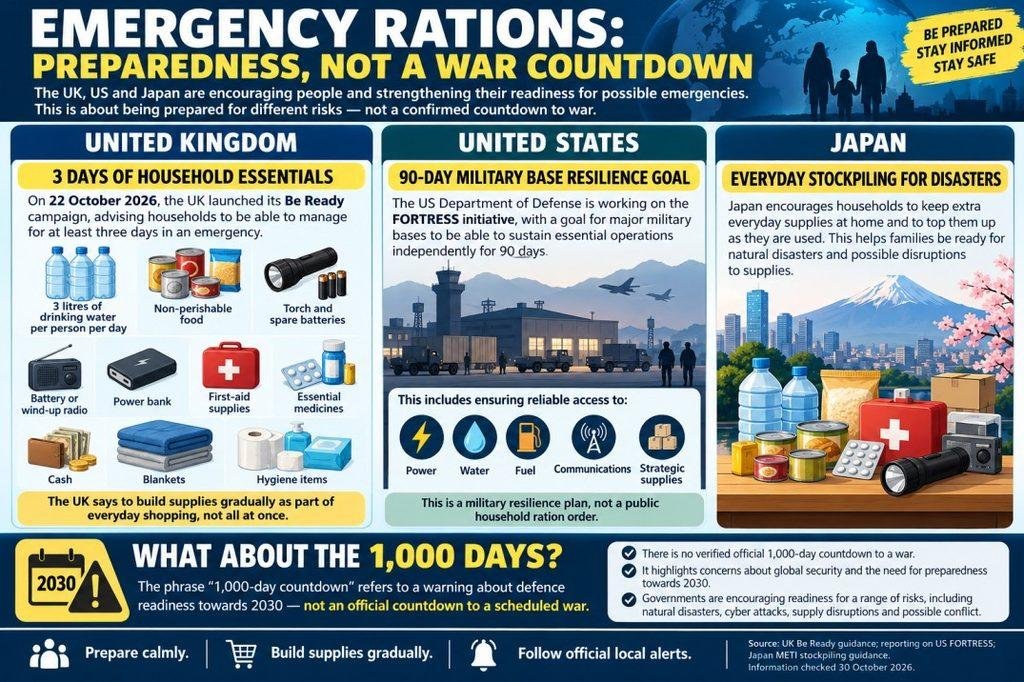
On October 22, 2026, the UK government launched its Be Ready campaign, encouraging households to prepare for at least three days of emergency disruption.The advice includes keeping essential supplies such as:
- Nine litres of drinking water for one person.
- Three days of non-perishable food.
- Flashlights and spare batteries.
- A first-aid kit and essential medicines.
- Cash for emergencies.
- A battery-powered or wind-up radio.
- Fully charged power banks.
- Blankets and warm clothing.
- Hygiene products and toilet paper.
The recommendation is based on approximately three litres of drinking water per person each day.The government explains that emergency services may need time to reach everyone during a major incident. Household preparation can reduce pressure on rescue teams and help vulnerable people receive assistance first.The campaign covers several possible risks, including extreme weather, cyberattacks, infrastructure failures, and hostile actions by other countries.Importantly, the government advises people to build their emergency supplies gradually rather than panic-buying everything at once.
2. The United States Is Strengthening Military Preparedness
The United States is also focusing on protecting important infrastructure and military facilities.In October 2026, reports highlighted a Pentagon initiative known as FORTRESS (Federal Operations for Resilience, Troop Resources, Energy, Supply, and Survivability).The initiative aims to make major American military bases capable of maintaining essential operations independently for up to 90 days.Why is this important?Military bases depend on electricity, fuel, water, communications, transportation, and equipment. If these systems are disrupted during a conflict, military operations could become difficult.
The reported plans include:
- Independent electricity generation.
- Energy storage and microgrids.
- Emergency fuel supplies.
- Strategic ammunition reserves.
- Medical supplies.
- Critical minerals and electronic components.
- Spare parts and alternative manufacturing arrangements.
These preparations are designed to reduce dependence on outside suppliers during a serious emergency.However, a military resilience programme does not automatically mean that a war is imminent. It shows that the US military wants to reduce its vulnerabilities before a crisis occurs.The United States also has long-standing public emergency preparedness programmes through FEMA, covering natural disasters and human-caused emergencies.
3. Why Is Japan Encouraging Emergency Stockpiling?
Japan faces a different but equally important set of risks.The country is particularly vulnerable to earthquakes, tsunamis, typhoons, floods, and other natural disasters.Major earthquakes can damage roads, electricity networks, communication systems, and water supplies. In some situations, supermarkets may run out of essential products because deliveries cannot reach affected communities.Japan has therefore encouraged households to maintain emergency supplies for many years.Its Ministry of Economy, Trade and Industry promotes a practice commonly called rolling stockpiling.This means purchasing slightly more of the everyday products a household normally uses, consuming older supplies first, and replacing them during regular shopping trips.
Common supplies include:
- Drinking water.
- Rice and packaged food.
- Canned vegetables and fish.
- Medicines.
- Batteries.
- Toilet paper.
- Hygiene products.
Japan’s approach is not simply about preparing for war. It is largely connected to the country’s experience with major natural disasters and the importance of keeping daily life running when supply chains are interrupted.
4. What Is the 1,000-Day Countdown About?
One of the most discussed aspects of the current situation is the reference to approximately 1,000 days remaining before 2030.British defence leadership has warned that Russia and other potential adversaries could become more capable of threatening NATO countries by the end of the decade.
The concern involves several developments:
- Increasing military spending.
- Expansion of defence production.
- Cyberattacks against important infrastructure.
- Sabotage and other forms of hybrid warfare.
- Growing international tensions.
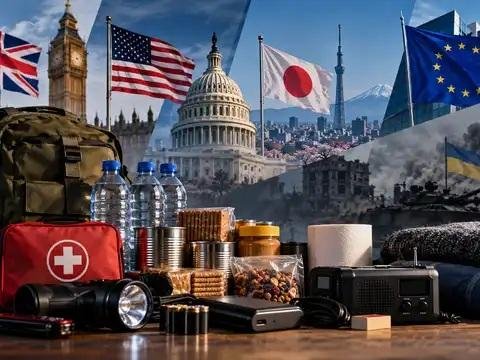
The argument is that NATO countries should strengthen their military capabilities and national resilience before potential threats become more serious.However, the phrase “1,000-day countdown” should not be interpreted as an official prediction that a world war will begin after exactly 1,000 days.It describes a defence preparedness timeframe associated with concerns about the security situation around 2030.There is no publicly verified NATO announcement confirming a scheduled war or a specific date for an attack.
5. Is Russia Preparing for a Possible Conflict With NATO?
Russia’s military actions and its confrontation with Western countries remain major security concerns.NATO members are increasingly concerned about the possibility of attacks that do not necessarily begin with conventional military operations.These threats are often described as hybrid warfare.
Hybrid warfare can involve:
- Cyberattacks against government systems.
- Disruption of electricity networks.
- Attacks on communication infrastructure.
- Sabotage of underwater cables and pipelines.
- Disinformation campaigns.
- Economic pressure and supply-chain disruption.
Such activities can create serious problems without a formal declaration of war.This explains why European countries, including Finland, Sweden, Poland, Estonia, Latvia, and Lithuania, have placed greater attention on civil defence and emergency preparedness.The objective is to make societies more resilient if normal services are disrupted.
6. Could the United States and Iran Face Another Major Military Escalation?
Another important development concerns tensions between the United States and Iran.According to a Wall Street Journal report published on October 28, 2026, the United States has warned several Gulf countries to prepare for a possible short but intense military campaign against Iran following the November 3 midterm elections.The report describes military preparations involving aircraft, missile defence systems, additional forces, and naval deployments.However, these reports do not establish that an attack is certain.Military planning and military action are two different things. Governments frequently prepare options that may never be used.Nevertheless, any escalation involving the United States, Iran, and other regional powers could affect global energy markets, international trade, shipping routes, and economic stability.This is a separate geopolitical concern and should not be confused with the reason behind every household emergency preparedness campaign.
7. Should Ordinary People Start Preparing for an Emergency?
Yes, but there is no reason to panic.Keeping basic emergency supplies at home is a sensible decision regardless of whether international tensions increase.A practical emergency kit can help during power cuts, floods, storms, earthquakes, cyber disruptions, and transportation problems.
Keep drinking water: Store enough safe drinking water for everyone in your household.
Maintain food supplies: Choose packaged foods with a long shelf life that your family normally eats.
Keep essential medicines: Make sure you have the medicines and medical supplies your household regularly needs.
Prepare for electricity failures: Keep flashlights, batteries, and charged power banks available.
Keep some cash: Electronic payment systems and ATMs may become temporarily unavailable.
Make a family emergency plan: Decide how family members will communicate and where they can meet if mobile networks stop working.
Follow reliable information: Pay attention to official government announcements instead of unverified social media claims.You do not need to purchase everything immediately. Building supplies gradually is a more affordable and practical approach.
Conclusion: Is a Major Global Event About to Happen?
The growing focus on emergency rations, military stockpiles, and national resilience is a sign that governments are taking global risks seriously.
The United Kingdom’s Be Ready campaign, America’s military infrastructure plans, and Japan’s disaster preparedness practices all reflect the importance of being prepared for unexpected disruptions.At the same time, tensions involving Russia, NATO, the United States, and Iran deserve attention.The reference to a 1,000-day countdown highlights concerns about the international security situation approaching 2030. However, it is not proof that a global war has already been scheduled or that an unavoidable catastrophe is approaching.The most sensible response is to remain informed, prepare essential household supplies, and avoid unnecessary panic.
Being prepared does not mean expecting the worst. It means being ready if the unexpected happens.
Frequently Asked Questions (FAQs)
1. Why are countries asking people to stock up on emergency supplies?
Governments want households to remain safe during emergencies involving natural disasters, cyberattacks, power outages, infrastructure failures, or military conflicts.
2. What is the 1,000-day countdown?
It is a reference to the defence preparedness timeframe leading towards 2030. It is not an officially confirmed countdown to the beginning of a world war.
3. How much water should people store for emergencies?
The UK’s October 2026 guidance recommends three litres of drinking water per person per day for three days, with additional water needed for cooking and washing.
4. Is World War III expected by 2030?
There are growing international security concerns, but no reliable evidence confirms that World War III will begin by 2030.
5. Why is Japan encouraging people to stockpile food and toilet paper?
Japan regularly promotes emergency stockpiling because earthquakes, tsunamis, and other natural disasters can interrupt transportation and essential supplies.
6. What is the US FORTRESS initiative?
FORTRESS is a Pentagon resilience initiative intended to strengthen military bases against disruptions to electricity, fuel, water, communications, and supply chains.
7. Should people panic and buy emergency food immediately?
No. People should prepare gradually, maintain reasonable supplies, and follow official emergency guidance rather than panic-buying.