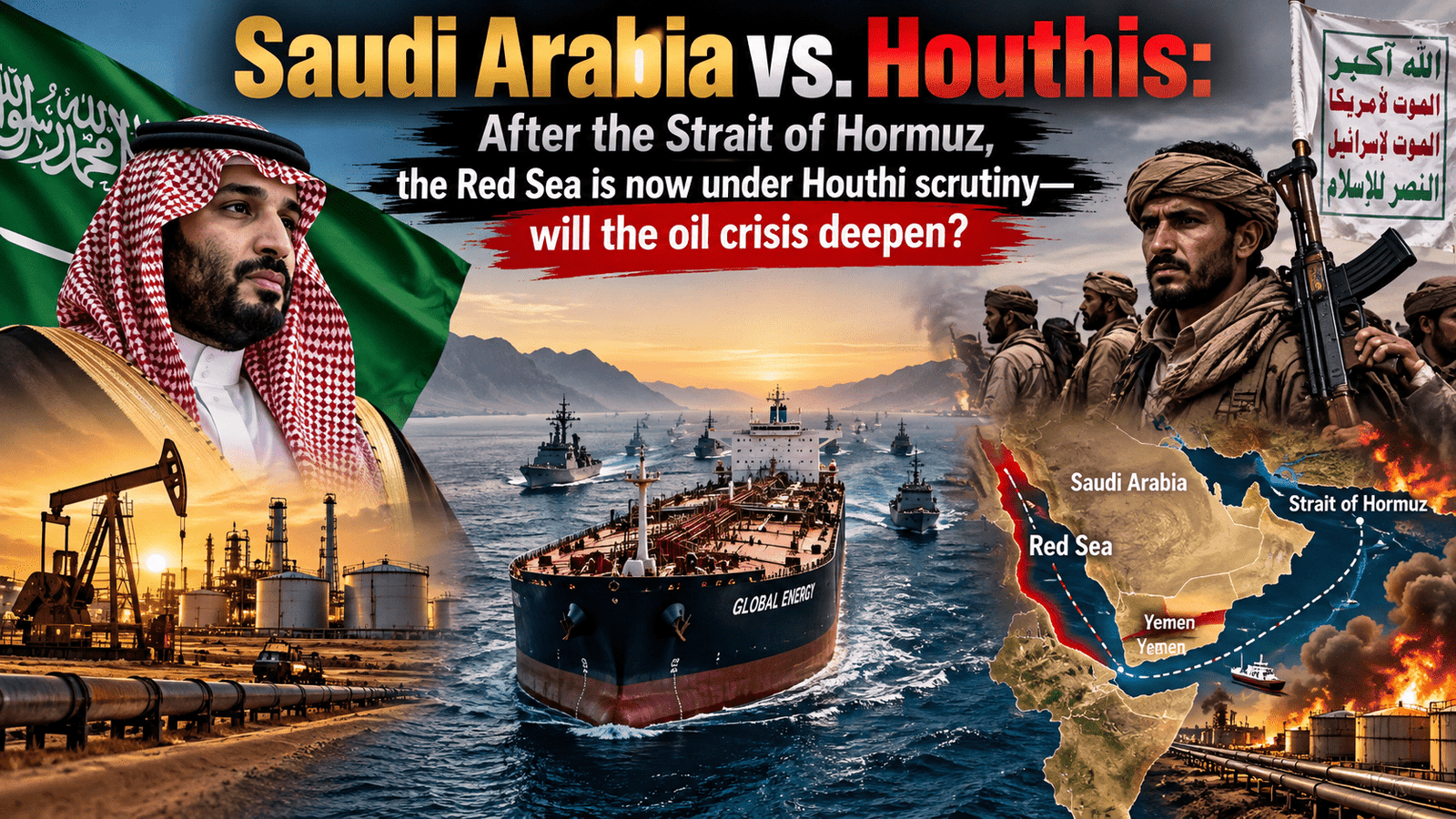
The global oil market is facing another major test.
After the Strait of Hormuz became severely disrupted, attention turned to the Red Sea as an alternative route for moving oil from the Middle East to international markets. Saudi Arabia had an important advantage: its East-West oil pipeline could transport crude from the oil-producing region in the east to Yanbu on the Red Sea, allowing some exports to bypass Hormuz.
But that alternative is now under pressure too.
A drone attack recently damaged Saudi Arabia’s East-West pipeline, forcing its temporary shutdown. At the same time, Yemen’s Houthis movement has intensified its military activity around the Red Sea and the Bab-el-Mandeb Strait. Together, these developments have raised fresh concerns about the security of one of the world’s most important energy corridors.
The central question is simple: If both Hormuz and the Red Sea become difficult to use, how will Middle Eastern oil reach the world market?
Why the Red Sea Matters to Global Oil Supplies
The Red Sea connects the Indian Ocean with the Mediterranean through the Bab-el-Mandeb Strait and the Suez Canal.
For oil producers in the Persian Gulf, this route can be extremely valuable. Tankers can reach international markets without relying entirely on the Strait of Hormuz.
Saudi Arabia has spent decades developing infrastructure to create precisely this kind of alternative.
Its East-West Pipeline, also known as Petroline, runs roughly 1,200 kilometers from the kingdom’s eastern oil-producing areas to Yanbu on the Red Sea coast. The pipeline has a maximum capacity of about 7 million barrels per day, although part of that capacity is used for western Saudi refineries and actual exports through Yanbu are considerably lower.
This infrastructure became especially important as shipping through Hormuz was disrupted.
The Pipeline Attack Changed the Equation
On September 11, Saudi Arabia shut down the East-West Pipeline after a drone attack.
Saudi authorities said the drones originated from Iraq, where Iran-backed armed groups operate. The shutdown was described as a precaution while technical teams assessed and secured the infrastructure.
The consequences could be significant.
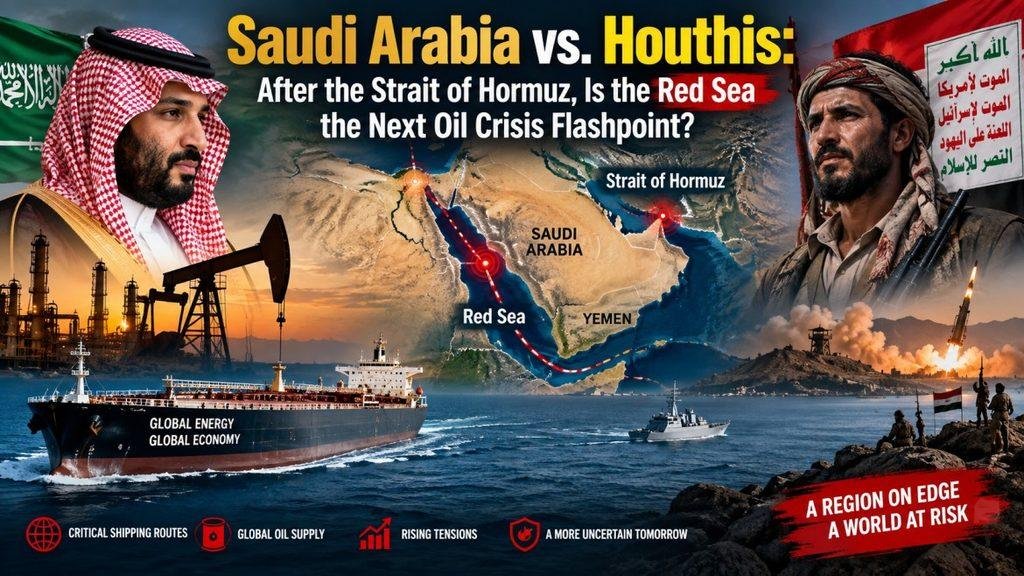
Reuters reported that Saudi Arabia had been using the pipeline to reroute around 4 million barrels per day toward Yanbu during the wider disruption. Industry sources said stocks at Yanbu could support exports for only several days if the pipeline remained offline.
The Associated Press subsequently reported that the pipeline could remain mostly out of service for weeks while repairs are carried out.
That creates a difficult situation for Saudi Arabia.
The kingdom has oil reserves and production capacity, but producing oil is only part of the problem. The oil must also reach a port and then a buyer.
The Outhit Factor: Why Bab-el-Mandeb Is Critical
At the southern end of the Red Sea lies the Bab-el-Mandeb Strait.
It is a narrow maritime passage separating Yemen from the Horn of Africa. Ships using the Red Sea to reach the Suez Canal must pass through this area.
That makes the waterway strategically important.
The Houthis, who control large parts of northern Yemen, have previously demonstrated their ability to threaten commercial shipping in the region. A U.S. maritime advisory continues to warn that vessels with certain Israeli, U.S. or UK connections can face heightened risks in the southern Red Sea, Bab-el-Mandeb and Gulf of Aden.
In July 2026, the Houthis announced a blockade of Saudi ports. Two tankers carrying Saudi crude from Yanbu subsequently reversed course in the Red Sea, illustrating how threats alone can affect shipping decisions.
This is important because an oil route does not need to be completely closed to become economically difficult.
If shipping companies believe an area has become dangerous, they may demand higher insurance premiums, use security escorts, change routes or delay voyages.
The result can be higher transportation costs and longer delivery times.
Why the Houthis Are Increasing Pressure on Saudi Arabia
The conflict between Saudi Arabia and the Houthis is not new.
Saudi Arabia led a military coalition against the Houthis in Yemen beginning in 2015. A period of relative de-escalation followed, particularly after 2022, but the wider regional conflict has created new tensions.
The Houthis are also closely aligned with Iran and are part of the broader network of Iran-backed armed groups operating across the Middle East.
That does not mean every Outhit decision is simply dictated by Tehran. The movement has its own political and military objectives in Yemen.
But the regional connection matters.
The confrontation involving Iran, Israel, the United States and several Middle Eastern actors has created an environment in which pressure on Saudi infrastructure and shipping can have consequences far beyond Yemen.
A Double Problem for Riyadh
Saudi Arabia now faces two connected challenges.
The first is land-based infrastructure security.
The East-West Pipeline was specifically valuable because it provided a route around the Strait of Hormuz. Its temporary shutdown therefore removes or reduces an important alternative.
The second is maritime security.
Even if Saudi Arabia moves crude successfully through the pipeline to Yanbu, the oil still has to leave the Red Sea.
If ships face serious risks near Bab-el-Mandeb, the pipeline alone cannot solve the problem.
This creates a difficult chain:
Oil field → East-West Pipeline → Yanbu → Red Sea → Bab-el-Mandeb → international market
A disruption at any major point can affect the entire system.
Can Saudi Arabia Find Another Route?
There are alternatives, but none are simple.
One possibility is moving oil through Egypt and using the Suez Canal. Another is longer-distance shipping around Africa’s Cape of Good Hope.
But these alternatives can add substantial sailing distance, fuel costs, freight expenses and delivery time.
Recent reporting has highlighted attempts to reroute Saudi crude through alternative routes, including ship-to-ship transfers and routes involving Oman.
However, alternative routes cannot automatically replace the capacity and efficiency of established infrastructure.
This is why the security of the Red Sea has become so important.
What Happens to Oil Prices?
When supply is threatened, oil markets tend to react before an actual shortage occurs.
Traders price in the possibility that future supplies could become tighter.
Recent disruptions have already pushed Brent crude above $100 per barrel, with Reuters reporting prices around $108 per barrel on September 13.
If Saudi exports fall for a prolonged period, the impact could spread beyond crude oil.
Refineries depend on reliable crude supplies. Refining costs can rise, fuel markets can tighten and transportation expenses can increase.
That can eventually affect petrol, diesel, aviation fuel, shipping and the prices of goods transported by road.
The effect would therefore not be limited to oil-importing countries in Asia or Europe.
Could the Global Oil Crisis Get Worse?
The answer depends largely on three factors.
1. How quickly the Saudi pipeline is repaired
A short shutdown would be disruptive but manageable.
A prolonged outage would create much greater pressure on Saudi export logistics.
2. Whether Bab-el-Mandeb remains open to commercial shipping
If shipping continues with manageable security risks, Saudi Arabia retains more options.
If major shipping companies avoid the route, the cost of moving oil could rise sharply.
3. Whether the wider Middle East conflict expands
This is perhaps the biggest uncertainty.
The Strait of Hormuz, Iraqi armed groups, Saudi infrastructure, Yemen and the Red Sea are geographically connected parts of the same regional security picture.
A new escalation in one area could quickly affect another.
Why This Matters for India and the Rest of Asia
Asian countries are particularly exposed to disruptions in Middle Eastern oil flows.
The region is a major source of crude for Asian refineries, and longer shipping routes can increase transportation costs.
For countries such as India, China, Japan and South Korea, even if oil continues to arrive, higher freight and insurance costs can affect the final price of petroleum products.
Governments and energy companies therefore have an incentive to diversify suppliers, maintain strategic reserves and develop alternative energy sources.
The crisis demonstrates a basic reality of global energy security:
Having oil underground is not enough. The world also needs safe and reliable routes to transport it.
Conclusion
The Red Sea was expected to provide an important alternative when the Strait of Hormuz became difficult to use.
But that alternative is now facing its own security problems.
The damage to Saudi Arabia’s East-West Pipeline has weakened one of the kingdom’s most important bypass routes, while Outhit pressure around the Red Sea and Bab-el-Mandeb has increased the risks facing maritime shipments.
This does not mean that the world’s oil supply will suddenly stop. Saudi Arabia and other producers still have storage, alternative routes and logistical options.
But the margin for disruption has become smaller.
The deeper concern is that several critical links in the Middle East energy network are now vulnerable at the same time.
If Hormuz remains disrupted, the Saudi pipeline stays offline for an extended period and Red Sea shipping becomes increasingly difficult, global energy markets could face another round of supply pressure.
The next phase of the crisis may therefore be decided not only by how much oil the Middle East can produce, but by which routes remain safe enough to carry that oil to the rest of the world.
Frequently Asked Questions
1. What is the East-West Pipeline?
The East-West Pipeline, also known as Petroline, is a Saudi oil pipeline connecting the country’s eastern oil-producing region with Yanbu on the Red Sea. Its maximum capacity is approximately 7 million barrels per day.
2. Why is Bab-el-Mandeb important?
Bab-el-Mandeb is the narrow maritime gateway between the Red Sea and the Gulf of Aden. Ships using the Red Sea route to or from the Suez Canal must pass through this area.
3. Why are the Houthis important to the oil market?
The Houthis have demonstrated the ability to threaten commercial shipping and Saudi interests around the Red Sea. Such threats can cause ships to change routes, increase insurance costs and make oil transportation more expensive.
4. Does the pipeline shutdown mean 7 million barrels of Saudi oil are lost every day?
No. Seven million barrels per day is the pipeline’s maximum capacity, not necessarily the amount being exported through Yanbu. Recent estimates of Yanbu loadings were significantly lower.
5. What could happen if Red Sea shipping becomes impossible?
Saudi Arabia and other exporters could use longer alternative routes, including routes involving the Suez Canal or around Africa. These alternatives can increase shipping time and costs.
6. Could this push oil prices higher?
A prolonged reduction in Middle Eastern oil exports could put upward pressure on crude prices. The actual impact would depend on the duration of the disruption, alternative supplies, inventories and the response of major oil producers.
7. Why does this matter to ordinary consumers?
Higher crude and transportation costs can eventually affect petrol, diesel, aviation fuel, shipping and the cost of goods. The impact depends on how long supply disruptions continue and how much alternative supply is available.