Introduction
The continuing U.S.-Iran conflict is being felt far beyond the Middle East. In the United States, the war has affected fuel prices, household budgets, political opinions and the defense industry. Few places illustrate the connection between military production and everyday American life more clearly than Kingsport, Tennessee.
Kingsport is home to the Holston Army Ammunition Plant, a major U.S. defense facility that has produced high explosives for decades. The plant manufactures explosive materials including RDX and HMX, which are used in a wide range of conventional military munitions. The U.S. Army describes Holston as a key part of the nation’s ammunition industrial base.
For generations, industrial work and defense manufacturing have been part of the local economy. That history gives the debate over the Iran conflict an unusual local dimension: residents are discussing the war while living in a community directly connected to America’s military supply chain.
Kingsport and the Holston Army Ammunition Plant
The facility commonly referred to as the Holston Army Ammunition Plant is located in Kingsport, Tennessee. It was established during World War II and has supported U.S. military operations through several major conflicts, including the Korean War and Vietnam War.
Today, Holston is operated for the U.S. government by BAE Systems. Its core role is the production of explosives used in military ammunition. Army documents identify Holston as a facility specializing in explosives, including HMX, RDX and newer insensitive-munitions formulations.
That makes Kingsport more than an ordinary industrial city when Americans discuss the country’s ability to sustain a major military operation. The plant is part of a broader defense network designed to ensure that the U.S. military has access to essential ammunition components.
Recent defense-industry reporting has also highlighted concerns about America’s limited explosives-production capacity. Holston is particularly important because of the concentration of high-explosive manufacturing capability in the United States.
How the Iran Conflict Changes the Conversation
The U.S.-Iran conflict has placed new attention on America’s ability to maintain military supplies over an extended campaign. A prolonged conflict requires not only aircraft, ships and missiles, but also the less visible materials that make those weapons possible.
For communities such as Kingsport, that national debate has a local face. Defense manufacturing provides employment and supports a long industrial tradition, while the same production is ultimately connected to military operations overseas.
The result is a complicated mixture of economic interest, patriotism, political loyalty and concern about the human and financial costs of war.
Strong Republican Roots in Kingsport
Kingsport and surrounding parts of northeastern Tennessee have long been associated with Republican politics. Tennessee itself has become one of the Republican Party’s strongest states, and President Donald Trump has maintained significant support among Republican voters across the region.
That political environment helps explain why support for Trump’s approach to Iran can remain relatively strong even as national approval ratings have weakened.
At the same time, political loyalty does not necessarily mean unconditional support for every policy. Voters can support Trump personally while questioning the length, cost or consequences of a military campaign.
That distinction is becoming increasingly important as the conflict continues.
Trump Faces Pressure Over the War and the Economy
Nationally, the Iran conflict has created a difficult political environment for Trump. A Reuters/Ipsos poll published on August 17 found Trump’s approval rating at 33%, his lowest of his presidency, while 64% of respondents said they disapproved of his performance. The poll also found widespread concern that the conflict could continue for a long time.
The economic consequences are a major part of the problem.
Gasoline prices have risen sharply during the conflict. Reuters reported on August 17 that the U.S. average had reached about $4.06 per gallon. The increase has put pressure on household budgets and businesses that depend heavily on transportation.
The increase is closely connected to disruption around the Strait of Hormuz, one of the world’s most important energy shipping routes. Continued tensions there have created uncertainty in global oil markets and contributed to higher fuel costs.
For working families, these consequences can feel more immediate than developments on a battlefield thousands of miles away.
Why Some Trump Supporters Are Rethinking Their Position
Trump’s political base has not disappeared, but there are signs of frustration among some Republican voters.
Recent reporting has identified several factors behind this dissatisfaction, particularly rising fuel prices, inflation and concerns about the continuing war. Axios reported that Trump’s support among some Republican voters had weakened as the 2026 midterm elections approached.
For younger voters, the situation can be particularly complicated. Some people who supported Trump in the 2024 election may still agree with parts of his domestic agenda while becoming less comfortable with the direction of U.S. foreign policy.
This does not mean that Kingsport is turning away from Trump as a whole. Rather, it shows that political opinions can change when national policies begin to affect people’s daily lives.
Support for Military Action and Concern About a Long War
Views on the Iran conflict are not simply divided between people who support the war and people who oppose it.
Some Americans believe military action is necessary to prevent Iran from obtaining a nuclear weapon and to protect U.S. and allied security interests. Trump has repeatedly presented preventing an Iranian nuclear weapon as a central justification for the campaign.
Others are increasingly concerned about the possibility of an open-ended conflict. The longer the war continues, the more questions arise about casualties, military spending, fuel prices and America’s ability to maintain its weapons supply.
That debate has particular relevance in Kingsport because the community is connected to the defense industry itself.
Connected to America’s Military Future
Holston’s history demonstrates how closely Kingsport has been connected to U.S. military preparedness. The plant was created during World War II and has continued operating through successive generations of American conflicts. The Army says Holston has produced explosive ingredients supporting military weapons for decades.
Today, modernization and capacity expansion remain important priorities for America’s ammunition industrial base. Government documents have described projects aimed at maintaining and expanding Holston’s ability to produce critical explosives.
This means the Iran conflict is not simply an overseas story for Kingsport residents. It also raises questions about the future of American manufacturing, defense spending and the role of industrial communities in national security.
What Kingsport’s Experience Tells Us
Kingsport offers a useful window into a broader American debate.
On one side is the belief that a strong military requires a strong domestic industrial base. Workers at facilities such as Holston contribute to that capability, and many residents may view defense production as an important source of jobs, security and national strength.
On the other side are the costs associated with prolonged military action. Higher fuel prices, inflationary pressure and uncertainty about the duration of the conflict can make voters reconsider whether the benefits of military action outweigh its costs.
These two perspectives can exist within the same community and even within the same household.
Conclusion
Kingsport’s relationship with the Iran conflict is shaped by its unique place in America’s defense industry. The Holston Army Ammunition Plant has been producing critical explosives since World War II and remains an important part of the U.S. military supply chain.
The city’s Republican political tradition also means that Trump continues to have a strong base of support in the region. Yet rising gasoline prices, inflation and concerns about a prolonged conflict are creating new questions for some voters.
Ultimately, the views of Kingsport residents reflect a much larger American dilemma: how to balance national security with economic stability, military strength with the costs of war, and political loyalty with changing circumstances.
As the Iran conflict continues, communities connected to America’s defense industry will remain an important part of the conversation about what the country can sustain—and what it is willing to pay—for a prolonged military campaign.
What Is the SAVE America Act Trump Mentioned While Referring to Gyanesh Kumar?
Introduction
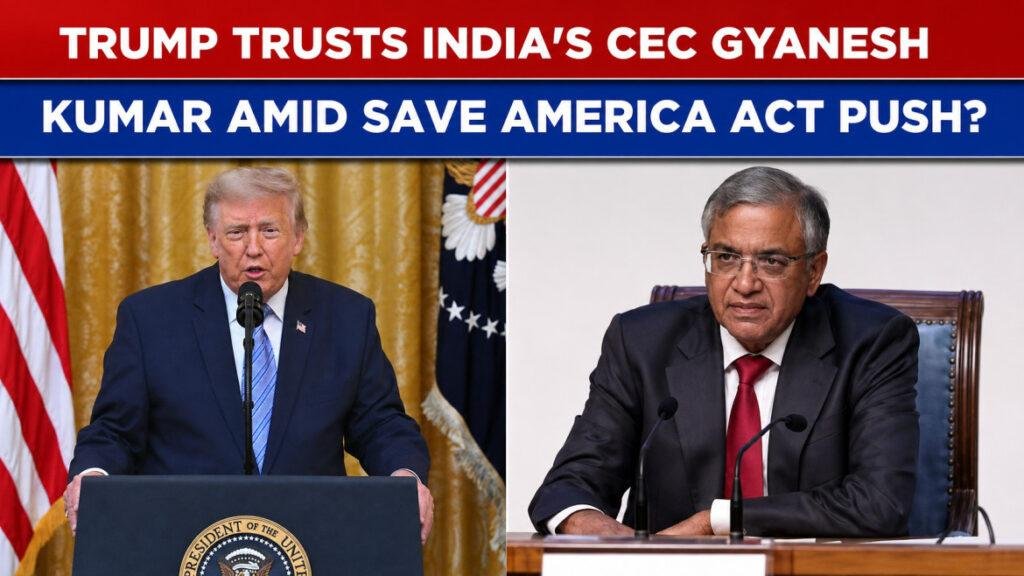
U.S. President Donald Trump has again put America’s voting rules in the spotlight, this time by pointing to India’s election system and referring to Chief Election Commissioner Gyanesh Kumar.
In a recent statement, Trump highlighted India’s use of voter identification and argued that the United States should adopt stricter rules for federal elections. He used the comparison to renew his call for passage of the Safeguard American Voter Eligibility Act, commonly known as the SAVE America Act.
The proposed legislation would make significant changes to how Americans register to vote and how voters identify themselves when casting ballots in federal elections. It would require documentary proof of U.S. citizenship for voter registration and introduce a federal photo-ID requirement for voting.
So, what exactly is the SAVE America Act, and why has Trump linked it to India’s electoral system?
What Is the SAVE America Act?
The Safeguard American Voter Eligibility Act, or SAVE America Act, is proposed federal legislation focused on voter eligibility and election identification.
The legislation’s central idea is that people registering to vote in federal elections should provide documentary proof that they are U.S. citizens. The 2026 version also includes requirements for voters to present specified photo identification when casting a federal ballot.
The measure builds on earlier versions of the SAVE Act that were introduced in Congress. A previous version, H.R. 22, passed the House in April 2025 but did not become law.
In February 2026, lawmakers used S. 1383 as a legislative vehicle for a revised SAVE America Act. The House passed that version on February 11, 2026, by a vote of 218-213.
Why Did Trump Mention Gyanesh Kumar?
Trump’s reference to Gyanesh Kumar was intended to strengthen his argument for stricter voter-identification requirements in the United States.
According to recent reports, Trump said that Kumar had questioned how U.S. elections could operate without a nationwide requirement for valid photo identification. Trump then pointed to India’s election system as an example of a large democracy using voter identification.
Trump’s argument is essentially that if India can operate elections involving hundreds of millions of voters while using voter identification, the United States should also be able to establish stronger identification requirements.
The comparison has attracted attention because election administration works differently in the two countries. India’s election system is administered nationally through the Election Commission of India, while U.S. elections are highly decentralized, with states and local jurisdictions playing major roles.
Frequently Asked Questions
1. Why is Kingsport important to the U.S. military?
Kingsport is home to the Holston Army Ammunition Plant, a major U.S. facility that produces explosive materials used in military ammunition.
2. What does the Holston Army Ammunition Plant produce?
Holston produces explosives including RDX and HMX, as well as newer explosive formulations used in conventional military munitions.
3. Is Kingsport a Republican-leaning city?
Kingsport is located in northeastern Tennessee, a region and state that have strongly favored Republican candidates in recent decades. However, individual opinions about Trump and the Iran conflict vary.
4. How has the Iran conflict affected Americans?
The conflict has contributed to higher energy prices and broader economic uncertainty. U.S. gasoline prices reached about $4.06 per gallon in mid-August 2026, according to Reuters.
5. Why are some Trump supporters becoming less satisfied?
Recent polling and reporting indicate that concerns about the prolonged Iran conflict, gasoline prices and inflation are contributing to declining approval of Trump, including among some Republican voters.
6. Has the Holston plant operated during previous wars?
Yes. The facility was established during World War II and has supported U.S. military requirements through subsequent conflicts, including the Korean War and Vietnam War.
What Would Change Under the SAVE America Act?
The legislation would make two major changes that are particularly important.
1. Proof of Citizenship for Voter Registration
Under the proposal, people registering to vote in federal elections would have to provide documentary proof of U.S. citizenship.
Acceptable documents could include a qualifying REAL ID showing citizenship, a U.S. passport, certain military documents, or government-issued identification combined with additional evidence such as a birth certificate or naturalization document.
The legislation also provides an alternative process for applicants who do not have one of the primary documents. They could submit other specified evidence and make an attestation under penalty of perjury that they are U.S. citizens and eligible to vote.
2. Photo ID When Voting
The 2026 version goes beyond the earlier SAVE Act by adding a federal photo-ID requirement for casting a ballot.
The proposed acceptable identification includes a qualifying state driver’s license, state-issued non-driver identification, U.S. passport, military identification or certain tribal identification containing a photograph and expiration date.
This is an important distinction. Earlier versions of the SAVE Act primarily focused on proof of citizenship when registering. The 2026 SAVE America Act also addresses identification when voting.
What Happens to Voter Rolls?
The proposed law would also require states to take ongoing steps to make sure that people who are not U.S. citizens are not registered to vote in federal elections.
States would be required to establish programs to identify potentially ineligible noncitizens using specified information sources. If verified information shows that a registered voter is not a U.S. citizen, the legislation would require removal from the relevant voter rolls.
Supporters say this would strengthen election security and ensure that only eligible citizens participate in federal elections.
Critics, however, have raised concerns about how these verification systems could affect eligible voters if government records are incomplete, outdated or incorrectly matched.
What Is the Argument in Favor of the Act?
Trump and supporters of the SAVE America Act argue that elections should contain strong safeguards to prevent unlawful voting.
Their position is straightforward: federal elections should be limited to eligible U.S. citizens, and voters should be able to prove their identity.
Supporters also argue that voter-ID requirements are widely supported by Americans. Republican lawmakers have repeatedly described photo identification as a common-sense election safeguard.
From this perspective, India’s use of voter identification provides an example that strict identification rules can operate in a very large democracy.
Trump has also repeatedly promoted the SAVE America Act on Truth Social, emphasizing voter ID, proof of citizenship and restrictions on some forms of mail voting.
Why Do Opponents Object?
Opponents of the legislation argue that the issue is not whether only citizens should vote. Federal law already prohibits noncitizens from voting in federal elections.
Instead, they focus on the additional documentation that eligible citizens would have to provide.
Critics say millions of Americans may not have easy access to the required documents or may face difficulties obtaining documents that prove citizenship, particularly after a legal name change.
They worry that the additional requirements could create obstacles for some eligible voters, including people who lack passports, birth certificates or qualifying identification.
The debate therefore centers on a basic question: How can elections be made secure without making it unnecessarily difficult for eligible citizens to vote?
How Are U.S. Voting Rules Different From India’s?
One major difference is that the United States does not have one nationwide voting system with identical identification rules.
States and local election jurisdictions play major roles in administering elections. As a result, voter-ID requirements already vary considerably across the country.
Some states require voters to present photo identification at polling places, while others accept different forms of identification or provide alternative procedures for voters who cannot show the required ID.
The federal government already has rules governing voter registration and eligibility, but there is currently no single nationwide federal photo-ID requirement for voting in federal elections.
This is why the SAVE America Act would represent a significant change.
Why Is the Debate Important in 2026?
The issue has become especially important as the United States approaches the 2026 midterm elections.
Midterm elections determine which party controls the House of Representatives and Senate for the next congressional term. Changes to voter registration and identification rules could therefore have major political consequences.
The debate is not simply about paperwork. It involves larger questions about election security, voting access, federal authority and the role of states in running elections.
Trump’s reference to India’s election system has added an international dimension to that debate.
Is the SAVE America Act Already Law?
No. The SAVE America Act is proposed legislation, not a law currently in force nationwide.
A version of the legislation passed the House in February 2026, but passage by the House alone does not make a bill federal law. The legislative process requires the measure to clear the Senate and receive the president’s signature, or otherwise become law through the constitutional process.
That distinction is important because Americans currently remain subject to the voting rules that are already in effect in their state and jurisdiction.
Conclusion
Trump’s reference to Chief Election Commissioner Gyanesh Kumar has brought fresh attention to the differences between India’s and America’s election systems.
The SAVE America Act would introduce stricter federal requirements for voting by requiring documentary proof of U.S. citizenship during federal voter registration and specified photo identification when casting a federal ballot. It would also require states to strengthen procedures for identifying and removing noncitizens from federal voter rolls.
Supporters view these measures as important safeguards for election integrity. Opponents worry that additional documentation requirements could create barriers for eligible voters.
Ultimately, the debate is about finding the right balance between election security and voting access. Trump’s comparison with India’s system has made that discussion even more prominent as the United States heads toward the 2026 midterm elections.
Frequently Asked Questions
1. What does SAVE stand for?
SAVE stands for Safeguard American Voter Eligibility.
2. What is the SAVE America Act?
It is proposed federal legislation that would require documentary proof of U.S. citizenship for federal voter registration and specified photo identification when voting in federal elections.
3. Did Trump create the SAVE America Act?
Trump has strongly supported and promoted the legislation, but the bill was introduced in Congress by lawmakers. Earlier versions were sponsored by Representative Chip Roy and Senator Mike Lee.
4. Is the SAVE America Act currently law?
No. A version passed the House in February 2026, but it is not automatically law simply because it passed the House.
5. Why did Trump mention Gyanesh Kumar?
Trump referred to India’s Chief Election Commissioner while arguing that the United States should adopt stronger voter-identification requirements similar to India’s system.
6. Does U.S. federal law already require voters to be citizens?
Yes. Federal law prohibits noncitizens from voting in federal elections. The proposed SAVE America Act would add documentary proof requirements to the registration process.
7. Would every voter need photo ID under the 2026 proposal?
The 2026 version of the SAVE America Act includes a federal photo-ID requirement for casting a ballot, with specified forms of identification accepted under the legislation.