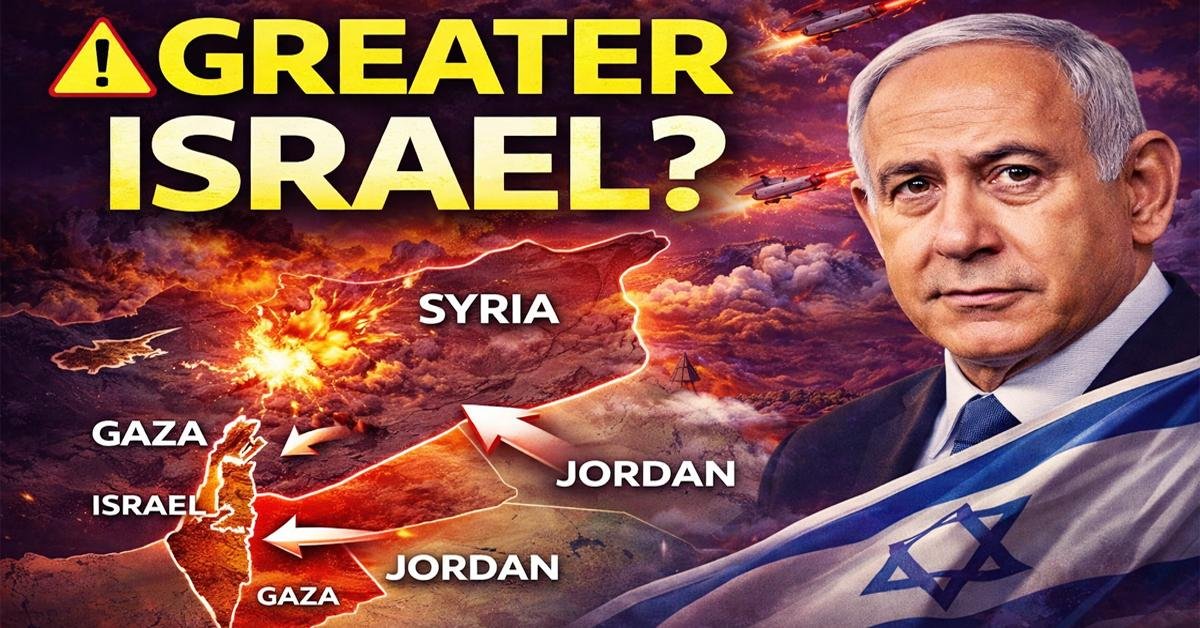
Does Netanyahu have his sights set on the entire Middle East?
Amidst escalating tensions with Iran, Israel has launched a ground offensive in Lebanon. In just 15 days, approximately 700 people have been killed, and 20% of the land in several regions has been cleared of its inhabitants; Israeli settlements are now being established there. Efforts are underway to turn the concept of ‘Greater Israel’ into reality—but what exactly is it?
‘Greater Israel’ is a concept envisioning a vast Jewish state stretching from the Nile River to the Euphrates River. References to this concept can be found in the biblical Book of Genesis, wherein God tells Abraham that this land will be bestowed upon his descendants. In addition to modern-day Israel and Palestine, this territory encompasses Jordan, Lebanon, Kuwait, Syria, and a significant portion of Iraq, as well as parts of Egypt, Turkey, and Saudi Arabia. Discussions regarding ‘Greater Israel’ intensified following the 1967 Arab-Israeli War, when Israel occupied the Gaza Strip and the West Bank. The idea of ’Greater Israel’ remains a widely discussed topic within Israeli society today. In an interview given to a television channel in August 2024, the Israeli Prime Minister stated, “I am on a historical and spiritual mission; I am deeply committed to the dream of Greater Israel.” God appeared to Abraham in a vision and promised to establish a great nation through his descendants. Abraham’s name was subsequently changed to ‘Israel,’ and it is from this point that his future generations came to be known as ‘Israelis.’ The Israelites endured a long period of slavery in Egypt before migrating to Canaan—the region corresponding to modern-day Israel and Palestine.
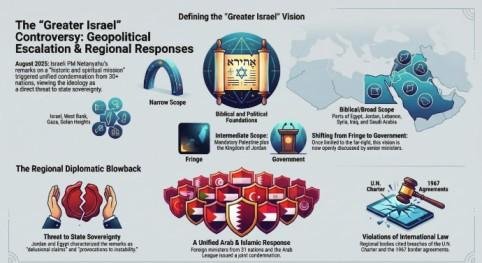
There, King Solomon commissioned the construction of the Jewish Temple in Jerusalem. Following his death, the kingdom fractured into two separate entities: the Kingdom of Israel and the Kingdom of Judah. Around 722 BCE, the Assyrian Empire launched an invasion of the Kingdom of Israel; the Temple was destroyed, and many… The Jews were forced to abandon their homeland after the state attacked Israel and Judea. The Temple was destroyed, and the Jews chose to kill one another rather than perish at the hands of the Romans. Subsequently, the majority of Jews migrated to Europe, where they were held responsible for the death of Jesus Christ. With the rise of nationalism in the 19th century, this animosity deepened even further. Witnessing the atrocities being committed against Jews worldwide, a decision was made to partition Palestine into two parts: 56% of the land was allocated to the Jewish state of Israel, while the remaining 44% was assigned to the Arab state of Palestine. Jerusalem was not granted to either nation; instead, it was declared an international zone. Israel was established on May 14, 1948; the very next day, several Arab nations launched an attack against it. During this conflict, approximately 750,000 Palestinians were displaced. On October 7, 2023, a new war erupted involving Israel. Now, on February 28, Israel—in conjunction with the United States—has launched an attack on Iran, a conflict that appears to be escalating as far as Lebanon. Many Arab nations oppose the concept of a “Greater Israel,” arguing that such a plan poses a threat to regional security in the Middle East and stands in violation of international law. As to whether a “Greater Israel” can be realized, experts suggest that, for now, it remains merely a theoretical concept. There are numerous significant obstacles standing in the way of its becoming a reality; its pursuit could exacerbate internal violence and instability, lead to increased civilian casualties, and result in a decline in international support, as nations such as the United States, European countries, and others may well oppose such a move.