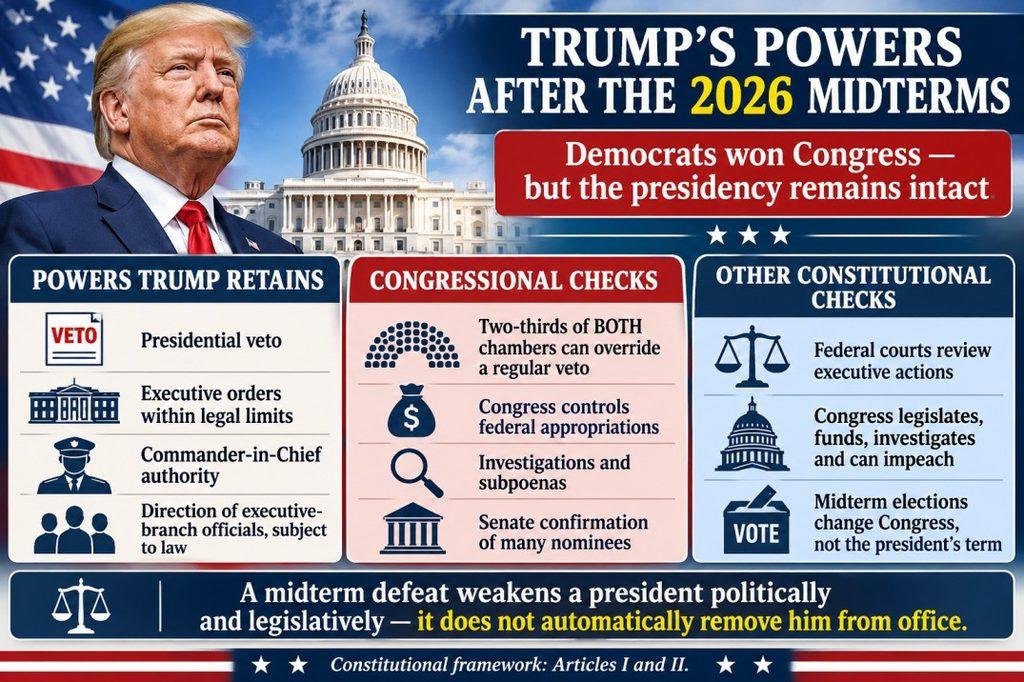
Donald Trump retains significant presidential powers despite the Democrats’ 2026 midterm victory. Explore his veto authority, executive orders, control over federal agencies and the constitutional checks available to Congress. Donald Trump’s Republican Party has suffered a major political setback in the 2026 US midterm elections, with Democrats securing control of both chambers of Congress. The outcome represents a significant challenge to Trump’s legislative agenda and could reshape the political landscape during the remaining two years of his presidency.However, losing congressional control does not mean losing presidential authority.The US Constitution establishes an independent executive presidency, meaning a president does not automatically leave office when the opposition wins a congressional majority. Trump retains important constitutional powers, including the presidential veto, executive authority and command of the armed forces.The central question is therefore not whether Trump can remain president, but how effectively Democrats can restrict his political agenda.
What does Trump’s midterm defeat mean?
The Democrats’ victory gives them control of both the House of Representatives and the Senate. According to Associated Press reporting, Democrats gained at least seven Senate seats and more than two dozen House districts. The result gives the opposition greater influence over legislation, investigations, appointments and federal spending
Three major issues contributed to the Republican setback:
- Cost of living: Inflation and high consumer prices remained major concerns for American voters.
- Foreign policy: Public dissatisfaction with Trump’s handling of the Iran conflict became an important electoral issue.
- Government accountability: Concerns about corruption and the administration’s direction also influenced voters.
Reuters reported that economic dissatisfaction and opposition to Trump’s policies were central factors behind the Democratic gains. Reuters+1
Nevertheless, the midterm elections do not constitute a presidential election. Trump continues to serve his constitutionally established term, which runs until January 2029.
Presidential veto: Trump’s strongest legislative weapon
One of the most important powers available to the American president is the veto, established under Article I, Section 7 of the US Constitution.
When Congress passes a bill, the president can:
- Sign it, making it law.
- Return it to Congress with objections, exercising a regular veto.
- Allow it to become law by taking no action within ten days, excluding Sundays, provided Congress has not adjourned in a way that prevents its return.
- A president cannot rewrite a bill through the veto process. He must accept or reject the legislation.
- However, Congress has a constitutional mechanism to overcome this obstacle. Both the House and Senate must approve the bill again by a two-thirds majority in each chamber.
- This makes the veto a powerful instrument, but not an absolute presidential authority. A pocket veto is a separate mechanism that can apply when Congress adjourns and prevents the president from returning the bill.
Executive orders and control over federal agencies
Another important presidential instrument is the executive order.Executive orders allow the president to direct executive branch departments and officials in carrying out federal laws and exercising lawful executive authority.Trump can use them to influence immigration enforcement, national security priorities, administrative policies and the functioning of federal agencies.However, executive orders cannot independently create legislation or override statutes passed by Congress. Courts can review them and block actions that exceed presidential authority or violate the Constitution.The Supreme Court’s June 2026 decision in Trump v. Slaughter also strengthened presidential removal authority over principal executive officers, including leaders of independent agencies such as the Federal Trade Commission. This gives Trump substantial influence over the executive branch, although the precise scope of removal authority depends on constitutional and statutory rules.
Foreign policy and military authority
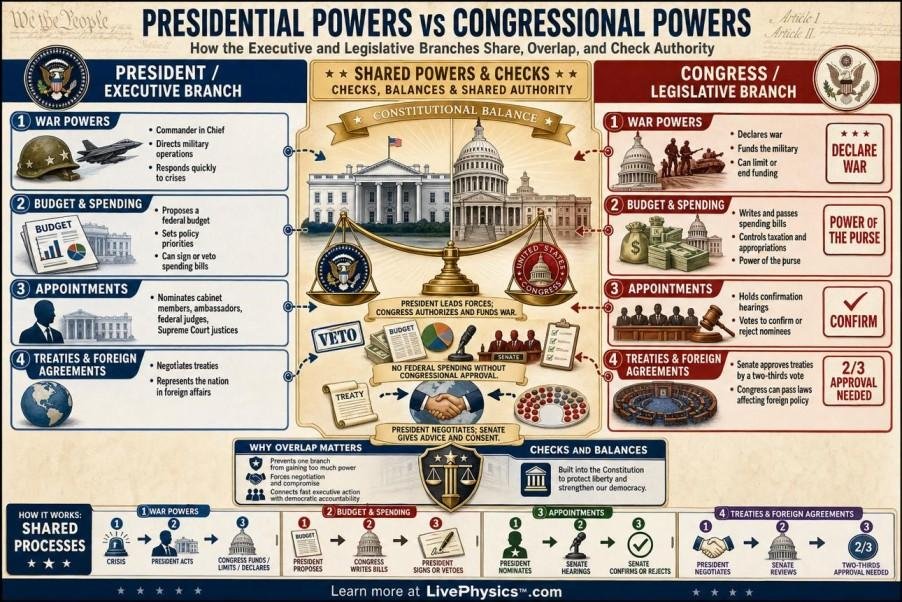
Article II of the Constitution designates the president as Commander-in-Chief of the US armed forces.This gives Trump considerable authority over military operations, diplomatic priorities and national security decisions.He can direct military commanders, shape foreign policy and negotiate international arrangements within constitutional and statutory limits.However, this does not mean the president possesses unlimited authority to wage war.Congress retains important powers, including declaring war, regulating military funding and overseeing defence policy. The Senate also exercises its constitutional role in treaty ratification and confirmation of important appointments.Consequently, even if Trump wishes to maintain his existing approach towards Iran, China, India or Israel, congressional opposition can create significant political and financial obstacles.
The power of the purse: Congress can restrict Trump’s spending
Perhaps the most significant challenge facing Trump is Congress’s constitutional authority over federal taxation and expenditure.The Constitution gives Congress the power to appropriate federal funds. This is commonly known as the power of the purse.Even when the president proposes a budget, Congress must approve the necessary appropriations. A Democratic-controlled Congress could
- Reject or reduce funding for particular government programmes.
- Refuse to approve additional spending requested by the administration.
- Demand greater financial transparency.
- Investigate alleged misuse of federal resources.
- This could significantly restrict Trump’s ability to implement certain policies, particularly those requiring substantial federal expenditure.
How can Democrats hold Trump accountable?
Democrats now have several important institutional tools.Congressional investigations: Committees can investigate government decisions, summon witnesses and issue subpoenas.Confirmation battles: The Senate can reject or delay presidential nominations requiring its advice and consent.Legislative opposition: Democrats can introduce legislation to reverse or restrict administration policies, although presidential vetoes remain an obstacle.Impeachment: The House can impeach the president by a simple majority. However, removing him requires conviction by a two-thirds majority of senators present.These mechanisms demonstrate that congressional opposition is not powerless. Nevertheless, each has different constitutional requirements and practical limitations.
Can Trump survive politically until 2029?
Yes. Losing control of Congress does not automatically threaten Trump’s constitutional position as president.The American political system separates the executive and legislative branches. Unlike parliamentary systems, a president does not need to maintain the confidence of a congressional majority to remain in office.However, the consequences of the midterm defeat could be substantial.Trump may face investigations, legislative resistance, funding disputes and difficulties securing approval for appointments. Republican lawmakers may also become less willing to support controversial presidential initiatives as political pressure increases.His remaining presidency could therefore become more confrontational, with greater reliance on executive authority and increased legal challenges.
Conclusion: Trump retains power, but his political freedom is shrinking
Donald Trump’s 2026 midterm defeat represents a major setback for his administration, but it does not eliminate his constitutional powers.His presidential veto, executive authority, control over the executive branch and Commander-in-Chief responsibilities remain significant sources of power.At the same time, Democrats now have greater opportunities to investigate the administration, influence federal spending, block legislation and challenge controversial executive actions.Ultimately, the American constitutional system is designed around checks and balances rather than unrestricted presidential authority.
Trump may remain president until January 2029, but governing without congressional support could make his final two years considerably more difficult.