
A trade agreement has been signed between India and the European Union (EU). This was announced by Prime Minister Narendra Modi. European Council President António Luís Santos da Costa and European Commission President Ursula von der Leyen were also present on the occasion. The government expressed hope that this trade deal would boost manufacturing in India. Earlier, the US had also reacted sharply to this agreement. Narendra Modi announced a trade deal between India and the European Union (EU). European Council President Antonio Luis Santos da Costa and European Commission President Ursula von der Leyen were also present on the occasion. Modi addressed Da Costa as the “Gandhi of Lisbon.” He stated that the largest free trade agreement was concluded today, on the 27th of the month. He called it a happy coincidence that India is signing this FTA with the 27 countries of the European Union on this very day. He said that this agreement will boost manufacturing in India and expand the services sector. He added that this free trade agreement will further strengthen confidence in India for every business and investor worldwide. Antonio Luis Santos da Costa said that the global world order is changing, and in this context, this partnership between India and Europe is historic. He said, “I had the pleasure of hosting you in May 2021 in my previous capacity. This sends a clear message to the world that at a time when the global order is being fundamentally challenged, the European Union and India stand together as strategic and reliable partners. Today, we are taking our partnership to the next level.” The Commissioner said in a press release that India will give the European Union tariff concessions that it has not given to any other trading partner. For example, tariffs on cars will be gradually reduced.


This is happening at a time when both India and Europe are facing trade tensions with the United States. US President Donald Trump had earlier threatened to escalate a trade war against European allies over their opposition to American control of Greenland, but later backed down. The US had also imposed an additional 25 percent tariff on India, citing the purchase of Russian oil. In total, the Trump administration had imposed a 50 percent tariff on India. Speaking to ABC News, US Treasury Secretary Steven Mnuchin said that the US has made more sacrifices than Europe to end the war in Ukraine. He said, “We imposed a 25 percent tariff on India because they were buying Russian oil, and look, in return, Europe is going to sign a trade deal with India.” The patient further stated that Russian crude oil goes to India, where it is refined, and then European countries buy the refined product. In other words, they are funding the war against themselves. Anyway, the Trump administration was determined to stop the Ukraine war. On January 24th, Scott Patient also said that they had imposed tariffs on India, which yielded positive results, but European countries refused to impose any tariffs on India regarding the purchase of Russian oil because they were about to sign a trade deal with them. Since the Ukraine war, India has been buying heavily discounted Russian oil, which Europe had banned. That oil went to Indian refineries, and, in a foolish move, Europe bought the same oil back from India. When the reporter asked if he was calling the European countries foolish, Scott Patient replied, “Not foolish, but yes, it is certainly a foolish act.”
India-European Union Trade Deal after 18 Years: Tariffs on Imported Luxury Cars Reduced from 110% to 10%, Premium Alcohol Tax Cut from 150% to 20%
After 18 years of lengthy negotiations, India and the European Union have reached a Free Trade Agreement (FTA). The announcement was made during the 16th India-EU Summit. India is entering into this FTA with the 27 countries of the European Union. This is a historic agreement that will make it easier for our farmers and small industries to access the European market, create new opportunities in manufacturing, and strengthen cooperation in our services sector. According to reports, the agreement is likely to be implemented in 2027. Following this deal, the tax on European cars like BMW and Mercedes in India will be reduced from 110% to 10%. Additionally, alcohol and wine imported from Europe to India could become cheaper, with the current 150% tax on European spirits being reduced to 20-30%. Meanwhile, the US is reportedly unhappy with the free trade agreement between India and the European Union. Europe buys refined oil products from India, which are made from Russian oil, thus indirectly financing Russia’s war efforts. India is the world’s fourth-largest economy, while the EU is the second-largest. Together, they account for nearly 50% of global GDP and approximately one-third of total world trade.
Has India found a way to counter Trump’s tariffs? A “mother of all deals” has been struck with the European Union. How will this affect you?
A Free Trade Agreement (FTA) was announced today between India and the European Union. This will make it easier for our small industries to access the European market, creating a combined market of 200 crore people that will account for 25 percent of the world’s GDP. Prime Minister Narendra Modi, along with the Council President and the President of the European Commission, has called it the “Mother of All Deals.” So what exactly is this “Mother of All Deals”? How will it affect you, and is this deal a response to Trump’s trade tariffs?
First, let’s understand what the India-EU “Mother of All Deals” is. When two or more countries agree to reduce or eliminate taxes or restrictions on each other’s goods and services, it is called a Free Trade Agreement. In the last four years, India has signed eight FTAs with countries like the UK, Oman, and the UAE. This agreement will create a market of 200 crore people, accounting for 25% of the world’s GDP. Secondly, amid the current global turmoil, the world is seeking alternatives to the US and China. In this scenario, this deal will help India rapidly become a production hub, replacing China, and will counter Trump’s tariffs. Thirdly, it will make it easier for both India and the EU to access each other’s markets, potentially doubling trade. Sumedha Dasgupta, a senior analyst at the EU, says that while the EU wants to reduce its dependence on China, both India and the EU need a reliable trade partner. Discussions between the two began in June 2007. At that time, it was called a Comprehensive Trade and Investment Agreement (CTIA). However, after 15 rounds of meetings, talks stalled because the EU wanted to eliminate tariffs on more than 95% of exports, while India was only willing to agree to 90%. Additionally, the EU was demanding a reduction in import duties on dairy products, wine, and cars, but India was against it. In 2022, talks between India and the EU resumed, and it was decided to plan for the elimination of tariffs on more than 90% of goods. For example, the 10% duty on Indian textiles and leather products could be reduced or eliminated. India will become a diversified supplier and manufacturing partner for the EU. This could strengthen the Indian defense industry, the pharmaceutical and chemical sectors could benefit from 20 to 30% more trade annually, and generic medicines made in India could be easily sold in Europe. Besides these, the Indian market could reap numerous other benefits. Now, let’s look at the potential reduction in the 150-200% duty on alcohol, which would increase demand. Premium European car companies would find it easier to enter the Indian market, as the current 110% duty could be reduced to 40%. Similarly, Europe’s IT, engineering, business services, and telecom sectors would also find more opportunities in India. But could the India-UK trade deal be affected by Trump’s tariffs? In this scenario, if an FTA is signed amidst US tariffs, the importance of the US to both blocs could diminish.
Why is the US so upset about the India-EU deal? Minister says India will benefit more from it. Will Trump’s Tariffs Become Ineffective?
The US is furious over the “Mother of All Deals” between India and the European Union. US Treasury Secretary Janet Yellen, while calling this deal more beneficial for India, said that trade is more important for Europe than the war in Ukraine, and that it is funding a war against itself. Why is the US so upset about this “Mother of All Deals” between India and the EU? And will India really benefit more from this deal? When two or more countries reduce or eliminate taxes on each other’s goods and services, it is called a Free Trade Agreement (FTA). Under this deal, India has either removed or reduced tariffs on 96.6% of European goods, and Europe has done the same for 99.5% of Indian goods. This collaboration will create a market worth $200 billion, accounting for 25% of the world’s GDP. On this, US Trade Representative Katherine Tai said that India will benefit more from this deal; they will get more opportunities to sell their goods in the European market. So, will India really benefit more from this deal? India exported goods worth $6.8 billion to Europe in 2022, while China exported $5.5 billion. According to a senior researcher at the Chinese Academy of International Trade and Economic Cooperation, the US is making such statements because its partners are not acting according to its expectations. Now, let’s understand that India will eliminate tariffs on 49.6% of goods imported from the EU, and on the remaining 39.5% of goods, tariffs will be eliminated in 5 to 10 years. In this scenario, the tariffs on European wines and premium European cars in India could be significantly reduced, which will increase their demand. Along with this, Europe’s IT, engineering, business services, and telecom sectors will also get more opportunities in India. So, will this deal render Trump’s tariffs ineffective? The US currently imposes a 50% tariff on Indian goods. According to the Global Trade Research Initiative, this tariff will cause a loss of approximately ₹3 lakh crore to the Indian domestic market in 2025-26. Economists say that the losses incurred can be compensated for through this deal with Europe. However, it is difficult to say whether complete compensation will be achieved. It’s possible that in three to four years, trade between India and the EU could reach around 22 trillion rupees. Now, let’s understand what worries the US about this deal. Currently, the US is the European Union’s largest trading partner, and trade between India and the US is also worth more than 12 trillion rupees. Therefore, the US fears that it might lose its biggest trading partner. The director of the Economy and Growth Program at the global think tank ORF says that the US has been continuously putting pressure on India with tariffs. The India-EU trade deal will force the US to acknowledge that India has other options and can pursue them. Experts say that the world has already suffered significant losses due to US tariffs. As a result, not only India and Europe, but other countries are looking for alternatives to the US.
Trump could seize $6.7 trillion from the world: Is this why countries are buying gold indiscriminately? Why is there so much turmoil behind the scenes globally?

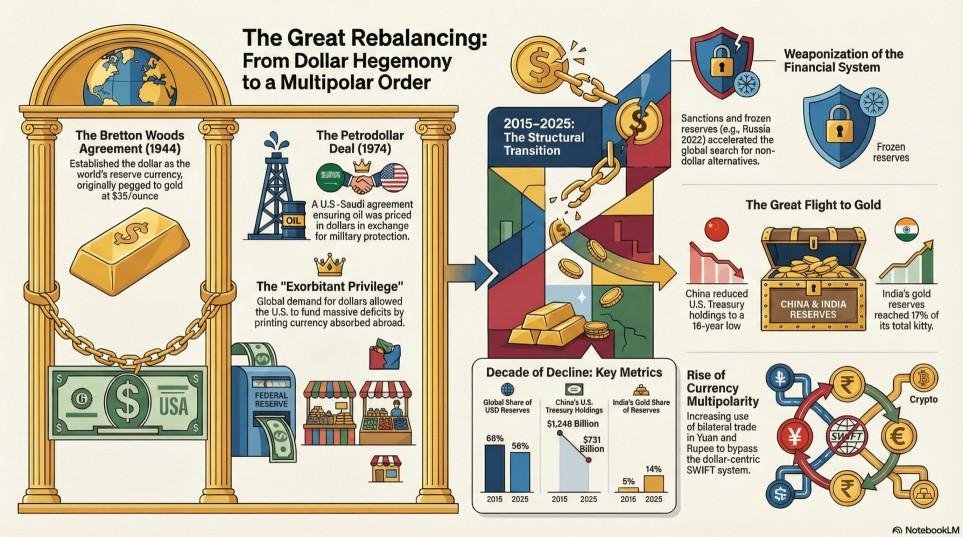
Gold, which was once rising slowly, is now making leaps of 10 to 20,000. The reason is clear: countries around the world are accumulating gold. But the story isn’t just about gold; the real game is the wavering trust in the dollar. How did the dollar become the world’s currency, and is the dollar’s dominance now in danger? From the history of currency to the questions being raised about the dollar, the complete story is in this Monday’s story. The story begins about 8000 years ago when people in Mesopotamia started exchanging goods for other goods according to their needs. This was called the barter system. Then, in 3000 BC, expensive items like copper and silver were used for transactions, and in 1200 BC, cowrie shells were used. After this, in 600 BC, King Croesus of Turkey started using gold and silver coins. Similar coins were also used in India. However, these coins felt like a burden to the people of China during their travels. Around the year 1000, paper currency started in China, which could be exchanged for gold or silver. This system spread throughout the world by 1870. At that time, Britain was the world’s largest exporter, and its pound sterling was worth about 7.2 grams of gold. 60% of global trade was conducted with this currency. But the dominance of the pound began to decline after the First World War. The countries involved in the war stopped printing their own notes and started buying raw materials and weapons from America in exchange for gold. This rapidly increased America’s gold reserves. Before the war, America had a debt of $2.2 billion, but now it had to collect $6.4 billion from other countries. Then, in 1939, during the Second World War, America earned a lot of money by selling weapons and goods, and European countries sank into debt. In such a situation, mutual trust between countries decreased, and in 1944, at a meeting of 44 countries, including India, in New Hampshire, USA, it was decided that all countries would now determine the value of their currency against the dollar instead of gold. The value of the dollar was pegged to gold. To help countries burdened by debt, the World Bank and the International Monetary Fund (IMF) were established, from where countries could obtain loans in dollars. This established the dollar as the base currency, and countries worldwide began holding dollar reserves. They also started demanding gold from the US in exchange for dollars.

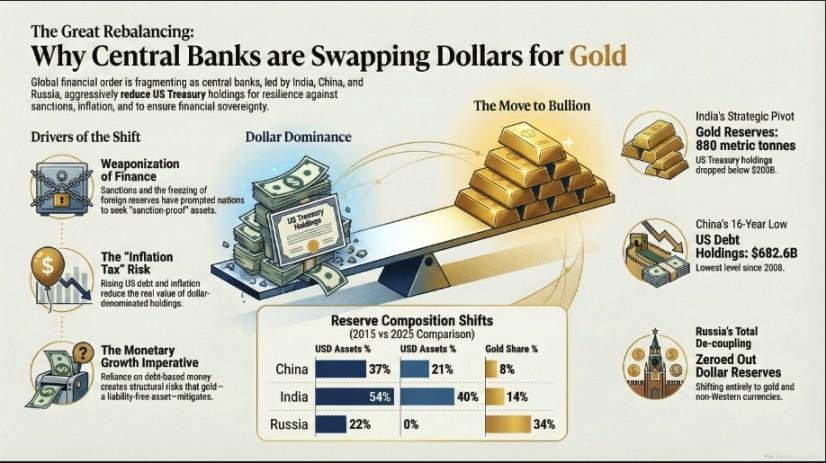
This led to a rapid depletion of the gold reserves the US had accumulated during World War II. Because of this, on August 15, 1971, US President Richard Nixon suspended the exchange of dollars for gold. This was known as the Nixon Shock. Since then, confidence in the dollar has rested not on gold, but on the US government and the principles of supply and demand. During this period, due to a lack of technology, Arab countries partnered with the US and Europe to increase oil production. However, during the 1973 Arab-Israeli war, the Arab countries stopped oil supplies in response to US support for Israel. This led to a deal between the US and Arab countries in 1974, under which the US provided security to the Arab nations in exchange for their selling oil in dollars. This further strengthened the dollar’s position. However, dependence on a single country’s currency was not considered safe, so countries have been searching for alternatives from the beginning. But when the US froze Russia’s $300 billion in assets during the 2022 Russia-Ukraine war, the whole world realized that the US could use the dollar as a weapon. Following this, many countries began using local currencies in foreign reserves and bilateral trade, and today, BRICS countries are distancing themselves from the dollar and working on other alternatives. However, whenever the US perceives a threat to the dollar, it immediately takes action. There are fears that the US might control around 6.7% of the world’s assets. Chris V., a founding partner at the consultancy firm Macro Advisory, says that US President Donald Trump’s decisions are unpredictable. The US also has a debt of $38 trillion. Because of this, the dollar is no longer considered a haven. Now, due to the declining trust in the dollar, countries like India and China are increasing their gold reserves and investing in other countries’ currencies. However, American economics professor Nouriel Roubini believes that the pace of the dollar’s decline is very slow, but an alternative to the dollar will eventually emerge. After the dollar, the euro is the most widely used currency in global trade. However, European countries are not pushing for the creation of this global e-currency, while the Chinese renminbi continues to be used, and the BRICS countries are also discussing creating a new currency.